AI Chatbot or Live Support: Smarter Choice for Business Growth

Ai chatbot or live support: smarter choice for business growth

Customer support has become a direct factor in business growth. A slow response, missed query, or poor support experience can push potential customers away, while fast and effective communication often improves trust, conversions, and long-term retention. As businesses handle growing customer expectations across websites, apps, and digital platforms, choosing the right support model has become more important than ever.

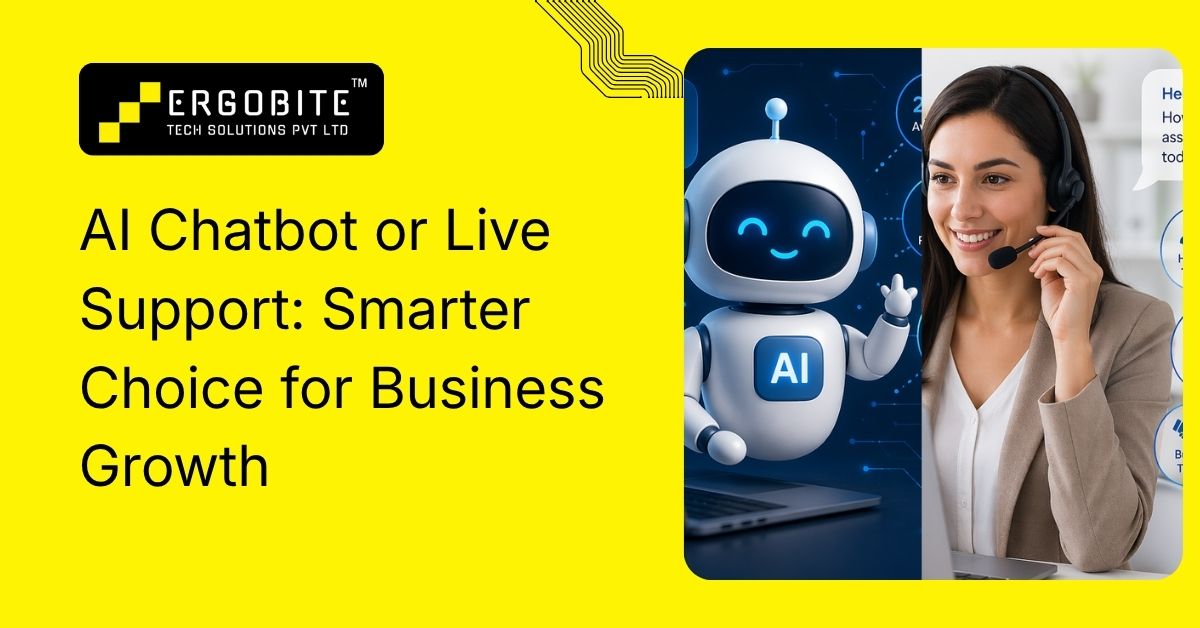
This is where AI chatbots and live support enter the conversation. AI chatbots help businesses manage large volumes of inquiries instantly, reduce repetitive workload, and stay available at any hour. Live support, on the other hand, brings human understanding into conversations that need attention, flexibility, and decision-making. Both can improve customer experience, but they solve different problems and deliver value in different ways.

Understanding where automation works best and where human interaction still matters is essential before deciding which approach supports your business growth more effectively.

How Do AI Chatbots Work in Customer Support?

AI chatbots function using a combination of Artificial Intelligence (AI), Natural Language Processing (NLP), Natural Language Understanding (NLU), and Machine Learning (ML) algorithms. When a user submits a query, the chatbot system performs intent recognition and entity extraction to understand the context of the message.

The system then processes the input using trained datasets or APIs connected to backend systems such as CRM, ERP, or knowledge bases. Based on predefined decision trees or deep learning models, the chatbot generates a relevant response in real time.

Modern chatbots also use contextual memory and sentiment analysis to improve conversation flow. Over time, ML models continuously retrain using historical chat data, making the system more accurate and adaptive. This enables chatbots to handle multi-session conversations, predictive responses, and automated ticket creation in helpdesk systems.

How Does Live Chat Support Work?

Live chat support operates through a real-time communication interface embedded in websites or applications, often integrated with customer support platforms like Zendesk, Freshdesk, or Intercom. When a customer initiates a conversation, the request is routed through a ticketing system or agent queue management system to an available support executive.

Agents use CRM dashboards to access customer profiles, purchase history, and previous interactions. This allows them to deliver personalized responses based on customer lifecycle data and behavioral analytics.

Unlike AI chatbots, live chat relies on human cognitive decision-making, emotional intelligence, and contextual reasoning to solve complex or non-linear queries. It is commonly used for escalation management, technical troubleshooting, and high-value customer interactions.

What Are the Key Differences Between AI Chatbots and Live Support?

Factor AI Chatbot Live Support
Availability 24/7 Limited to working hours
Response Time Instant Depends on agent availability
Cost Lower operational cost Higher staffing cost
Personalization Moderate High
Scalability Highly scalable Limited by team size
Complex Queries Limited capability Handles complex issues well

This comparison highlights that both solutions serve different purposes and can complement each other.

What Are the Major Advantages of Using AI Chatbots for Business Growth?

  • Provides 24/7 customer support, ensuring users get assistance anytime without delays
  • Reduces operational costs by automating repetitive queries and minimizing the need for large support teams
  • Delivers instant responses, improving customer satisfaction and engagement
  • Easily scales to handle multiple conversations simultaneously without performance issues
  • Helps in lead generation by capturing user data and qualifying prospects efficiently
  • Streamlines customer journeys, especially in e-commerce and SaaS businesses, boosting conversions and sales

According to a 2023 Statista survey, around 60% of US customers prefer chatbots because they are available 24/7, while 45% appreciate getting instant answers to their queries.

What Are the Common Limitations and Drawbacks of Live Customer Support Systems?

Common Limitations of Live Customer Support

  • Limited Availability – Live support is usually available only during business hours unless companies invest in shift-based teams, which can lead to delayed responses during nights, weekends, or holidays.
  • Difficult to Scale Quickly – As customer demand increases, businesses need to hire more agents. This makes scaling slower and more resource-intensive compared to automated systems.
  • Inconsistent Customer Experience – Service quality may vary from one agent to another depending on their skills, knowledge, and communication style, which can affect overall customer satisfaction.

Common Drawbacks of Live Customer Support

  • High Operational Costs – Maintaining a live support team involves expenses like salaries, training, tools, and infrastructure, making it costly for many businesses.
  • Human Errors – Agents may sometimes misunderstand queries or provide incorrect information, which can impact customer trust and experience if not handled properly..

How to Choose Between AI Chatbots and Live Support for Your Business?

The right choice depends on your business goals and customer expectations.

Choose AI Chatbots If:

  • You want to automate repetitive tasks
  • You need 24/7 availability
  • You want to reduce operational costs

Choose Live Support If:

  • You deal with complex customer queries
  • Customer relationships are a priority
  • You offer high-value or personalized services

AI chatbots are most useful for businesses that deal with a large number of repetitive customer queries and need to respond quickly. Companies that receive frequent questions about products, services, orders, or basic support can use chatbots to handle these tasks automatically, saving time and improving response speed.

What Will Customer Support Look Like in the Future?

Customer support is evolving quickly as new technologies continue to improve how businesses interact with customers. With advancements in AI and automation, companies are now able to provide faster, smarter, and more efficient support experiences. Tools like conversational AI, voice assistants, and integrated CRM systems are helping businesses streamline communication and better understand customer needs.

At the same time, the future of customer support will not be fully automated. While AI will handle routine and repetitive tasks, human support will remain essential for complex and sensitive interactions. The focus will be on creating a balanced approach where automation improves efficiency and humans deliver personalized, high-quality experiences

Take Your Customer Support to the Next Level

If you’re looking to strike the perfect balance between AI chatbots and live support, Ergobite Tech Solutions is here to help. We specialize in AI Chatbot Development Services, building smart, scalable, and customer-focused support systems tailored to your business needs. Whether you want to automate customer interactions, improve response time, or enhance overall customer experience, our solutions are designed to make support more efficient and effective.

Let our team of experts at Ergobite Tech Solutions be your trusted guide in choosing the right solution for your business growth. Contact us today to transform your customer support into a powerful growth engine and stay ahead of the competition.

Disclaimer : The information provided in this blog is for general informational purposes only and does not constitute professional business, technical, or financial advice. While every effort has been made to ensure accuracy, the effectiveness of AI chatbots and live support solutions may vary depending on specific business needs, industry, and implementation. Readers are advised to conduct their own research or consult with a qualified professional before making any business decisions.