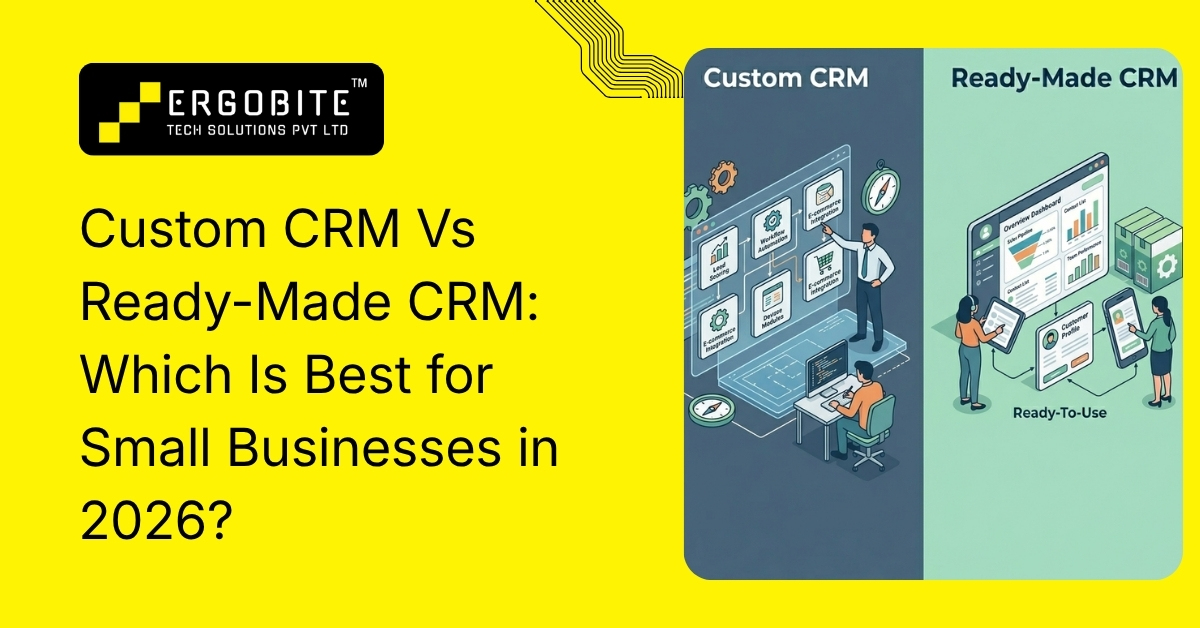
Detailed Comparison Between Custom CRM and Ready-made CRM
1. Initial Cost
Ready-Made CRM
Ready-made CRM platforms usually work on monthly or yearly subscription models, making them easier to adopt during the early stage of business growth. Businesses can start with smaller plans and upgrade gradually as requirements increase.
Custom CRM
Custom CRM solutions require a higher upfront investment because the platform is built according to specific operational requirements. The cost generally includes development, integrations, testing, UI design, and deployment.
Although the initial investment is higher, businesses gain complete ownership and long-term flexibility.
2. Set up and Implementation
Ready-Made CRM
One of the biggest advantages of ready-made CRM systems is faster deployment. Businesses can usually start managing leads and customer communication within a few days.
Most CRM providers also offer onboarding support and training resources to simplify implementation.
Custom CRM
Custom CRM systems require more planning and development because workflows, automation logic, and integrations are built according to business operations.
Depending on project complexity, implementation may take several weeks or months.
3. Customization Flexibility
Ready-Made CRM
Ready-made CRM platforms allow basic customization such as editing dashboards, reports, or sales pipelines. While this works well initially, operational limitations often appear as businesses scale.
Many companies eventually realize that the platform cannot fully support their exact workflow requirements.
Custom CRM
Customization is where custom CRM solutions become significantly stronger.
Businesses can build:
- Industry-specific workflows
- Workflow-based triggers
- Automated approval systems
- Department-wise dashboards
- Custom reporting structures
- Advanced sales funnel visibility
- Personalized customer journeys
This allows businesses to optimize operations instead of adjusting workflows according to software limitations.
4. Scalability
Ready-Made CRM
Ready-made CRM systems work effectively for small and medium-sized businesses. However, companies often face restrictions related to workflow automation, integrations, reporting flexibility, or user limits as operations become more complex.
Scaling usually requires upgrading to expensive enterprise plans.
Custom CRM
Custom CRM systems are designed according to long-term operational goals. Businesses can continuously expand features, automation layers, dashboards, and integrations according to growth requirements.
This makes custom CRM solutions more scalable for businesses planning long-term expansion.
5. Integration Capabilities
Ready-Made CRM
Most ready-made CRM platforms support standard integrations with email tools, marketing platforms, and payment systems. However, advanced integrations may require premium plans or external middleware tools.
Businesses also commonly experience limitations while connecting internal systems.
Custom CRM
Custom CRM solutions allow businesses to create API based integrations according to operational requirements.
This may include:
- ERP software
- Accounting systems
- HR platforms
- WhatsApp APIs
- Marketing automation tools
- Mobile applications
- Internal databases
For businesses managing multiple software systems, this flexibility becomes highly valuable.
6. Automation and Workflow Management
Ready-Made CRM
Ready-made CRM systems provide standard automation features such as reminders, email sequences, task notifications, and basic lead assignment.
These features work effectively for businesses with simpler workflows.
Custom CRM
Custom CRM systems allow businesses to automate operations according to exact workflow logic and business rules.
For example, businesses can automate:
- Lead routing workflows
- Customer onboarding
- Invoice generation
- Internal approvals
- SLA monitoring
- Follow-up reminders
- Service notifications
- Omnichannel communication tracking
This reduces repetitive manual work and improves operational efficiency across departments.
7. Long-Term Cost
Ready-Made CRM
Many businesses choose ready-made CRM systems because the starting investment appears lower. However, long-term costs often increase through:
- Per user pricing
- Premium upgrades
- Automation add-ons
- API access fees
- Storage upgrades
- Enterprise plans
As operations grow, recurring subscription expenses can become substantial.
Custom CRM
Custom CRM solutions involve a higher upfront investment, but businesses avoid many recurring licensing and subscription costs later.
Over time, growing businesses often find custom CRM more cost-effective because they gain ownership and better scalability.
Why Ready-Made CRM Works Well in the Early Stage
For many startups and small businesses, ready-made CRM platforms provide the simplest entry point into customer management systems.
Businesses can quickly organize customer data, improve follow-ups, and gain better sales visibility without major technical investment.
Some of the biggest advantages include:
- Faster deployment
- Lower starting cost
- Easy onboarding
- Built-in support
- Mobile accessibility
- Standard automation features
For businesses with straightforward sales processes, ready-made CRM systems often provide enough functionality during the early growth stage.
Where Ready-Made CRM Starts Creating Limitations
Although ready-made CRM platforms work well initially, operational limitations often become visible as businesses scale.
One of the biggest issues is workflow restriction. Since these platforms are built for broad business use, they cannot fully adapt to every company’s operational structure.
Businesses also commonly face:
- Limited workflow flexibility
- Restricted customization
- Expensive enterprise upgrades
- Dependency on third-party providers
- Increasing subscription cost
- Integration limitations
Over time, teams may spend more effort adjusting workflows according to platform restrictions instead of improving operational efficiency.
When Custom CRM Makes More Sense
Custom CRM becomes valuable when businesses require deeper operational control and workflow automation.
This usually happens when companies:
- Manage large customer databases
- Operate across multiple departments
- Require advanced reporting
- Use multiple software systems
- Need centralized operational visibility
- Require industry-specific automation
For example, an education company managing admissions, fee tracking, counseling workflows, and student communication may require automation that standard CRM platforms cannot support effectively.
Similarly, service businesses managing support tickets, SLA timelines, and multichannel communication often require centralized workflow automation that goes beyond standard CRM functionality.
In such cases, custom CRM solutions provide better operational efficiency and flexibility.
The Real Cost Difference Most Businesses Ignore
Many businesses compare CRM platforms only based on initial pricing, but the real financial impact becomes visible over time.
Ready-Made CRM Cost Structure
ready-made CRM systems generally involve recurring expenses such as:
- Monthly subscriptions
- Per user pricing
- Premium automation features
- API usage fees
- Storage upgrades
- Enterprise plans
As operations scale, these recurring costs can increase significantly.
Custom CRM Cost Structure
Custom CRM systems generally involve:
- Development cost
- UI and workflow design
- API integrations
- Hosting infrastructure
- Maintenance
- Future upgrades
Although the upfront investment is higher, businesses gain greater ownership and avoid many recurring licensing expenses later.
How AI Is Changing Modern CRM Systems?
CRM systems are evolving rapidly, with AI-driven automation becoming a major part of modern business operations.
Businesses now expect CRM platforms to provide more than customer data storage. Modern CRM systems increasingly support:
- AI lead scoring
- Predictive sales forecasting
- Smart follow-up suggestions
- Customer intent tracking
- Automated communication workflows
- Sales pipeline insights
- Customer behavior analysis
As AI adoption continues to increase, businesses should also evaluate whether their CRM platform can support future automation and scalability requirements.
Which CRM Is Better for Small Businesses?
A ready-made CRM is usually the better option for businesses that:
- Need quick implementation
- Have smaller teams
- Want a lower initial investment
- Manage simpler workflows
- Do not require advanced customization
A custom CRM becomes the better choice for businesses that:
- Require advanced workflow automation
- Need API based integrations
- Manage multiple departments
- Require centralized operational visibility
- Need industry-specific workflows
- Are you planning long-term scalability
If your business mainly needs lead management and customer tracking, a ready-made CRM can work effectively for years. However, if operations are becoming more complex and your team is spending more time adjusting workflows than focusing on growth, investing in a custom CRM may provide significantly better long-term value.
Final Verdict
A CRM should reduce operational friction, not create more of it.
For startups and early-stage businesses, ready-made CRM platforms often provide the fastest and most affordable way to organize customer management processes. They are easier to implement and require less technical investment initially.
However, as businesses scale, operational complexity also increases. Teams require better automation, deeper integrations, centralized visibility, and workflows designed specifically around business operations. This is where custom CRM solutions become more valuable.
Businesses that choose CRM systems based only on current pricing often outgrow them quickly. The better approach is selecting a platform that can support both present operations and future scalability without forcing teams to rebuild workflows later.
Choosing the Right Technology Partner for Custom CRM Development
Building a scalable CRM system requires more than basic software development. Businesses often need workflow automation, API based integrations, centralized dashboards, AI-driven insights, and systems that align with long-term operational goals. This is why many companies prefer working with an experienced AI ML development company like Ergobite Tech Solutions that understands both business workflows and modern automation technologies.
A well-developed custom CRM can help businesses improve operational efficiency, automate repetitive tasks, centralize customer data, and create better visibility across departments as operations continue growing.
Disclaimer: This blog is published for informational purposes only. CRM requirements may vary depending on business operations, industry, and scalability needs. Any third-party tools or platforms mentioned are referenced only as examples and do not represent official partnerships or endorsements by Ergobite Tech Solutions. Businesses should evaluate their requirements carefully before choosing any CRM solution.