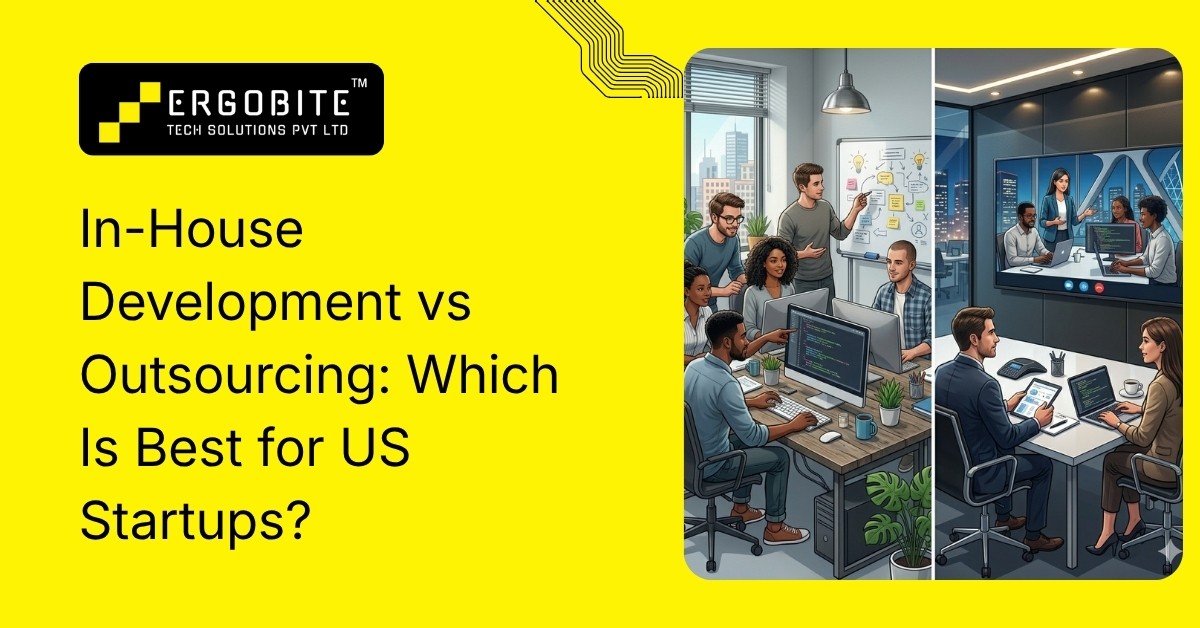
In-House Development vs Outsourcing: Which Is Best for US Startups?

A startup can spend months hiring developers and investing heavily in building an internal team, only to realize the product launch is delayed. On the other hand, some startups outsource development to move faster, but later face communication challenges or concerns about control.
The real challenge is not choosing between in-house development and outsourcing. The challenge is choosing the approach that fits your startup’s goals, budget, and growth stage.
The decision can influence how quickly you launch, how much you spend, how easily you scale, and how efficiently your product evolves in the future. There is no universal winner because every startup has different priorities.
This guide will help you understand both approaches and decide which one makes the most sense for your business.
Why This Decision Matters for US Startups
Building a startup in the US comes with opportunities, but it also comes with pressure. Businesses often need to move quickly while managing costs and staying competitive.
Many startups face common challenges such as:
- Limited funding during early stages
- Pressure to launch products quickly
- Rising hiring and operational costs
- Competition for skilled developers
- Constant feature updates and product improvements
Hiring technical talent is becoming increasingly competitive. According to the US Bureau of Labor Statistics, employment for software developers, quality assurance analysts, and testers is projected to grow 15% between 2024 and 2034, which is much faster than the average for all occupations. Growing demand means startups often compete for skilled talent and may face longer hiring timelines. A wrong development decision can create delays and unnecessary expenses. A well-planned decision can improve efficiency and support long-term growth.
This table gives a quick direction, but understanding the details behind each option is important before making a decision.
What Is In-House Development?
In-house development means building an internal team that works directly for your company. This team may include developers, designers, testers, project managers, and other technical professionals.
Many companies choose this approach because they want direct control over product development and long-term ownership.
Benefits of In-House Development
Full project control
Internal teams work closely with business leaders, making it easier to monitor progress and make changes quickly.
Better communication
Since everyone works under the same structure and goals, communication is often smoother and faster.
Strong company culture
Team members understand the company’s vision and become more connected with long-term business goals.
Better product ownership
Over time, internal teams build deep product knowledge that helps with future updates and improvements.
Challenges of In-House Development
Higher hiring costs
Building a team involves much more than salaries. Startups may also need to manage recruitment, employee benefits, equipment, software tools, and onboarding expenses.
Software hiring costs continue to increase because demand remains strong. Around 129,200 openings each year on average for software developers, quality assurance analysts, and testers. Higher demand often means startups need more time and resources to hire the right people.
Longer hiring process
Finding experienced developers can take several weeks or even months.
Difficulty scaling quickly
If a project suddenly needs additional resources, hiring more employees may slow progress.
Talent availability challenges
Many startups compete for skilled professionals, making recruitment difficult.
What Is Outsourcing in Software Development?
Outsourcing means hiring an external development company or technology partner to build your software product.
Instead of building an internal team from scratch, startups work with experienced professionals who are ready to begin development.
Benefits of Outsourcing
Lower initial investment
Startups can reduce recruitment and infrastructure expenses and pay only for required services.
Faster project execution
External teams often have developers available immediately, which can reduce development timelines.
Access to global talent
Businesses can work with specialists from different locations and technologies.
Flexible team expansion
Projects can scale faster without going through lengthy hiring processes.
Specialized expertise
Outsourcing companies often work across multiple industries and technologies, bringing valuable experience.
Challenges of Outsourcing
Communication differences
Working across different locations and time zones may sometimes create communication gaps.
Less direct control
Internal teams generally provide more visibility into daily activities and decision-making.
Security concerns
Sensitive business information requires proper agreements and protection measures.
Quality variation
The quality of work can vary depending on the development partner selected.
In-House Development vs Outsourcing: Key Comparison
Here is a side-by-side comparison:
| Factor | In-House Development | Outsourcing |
|---|---|---|
| Initial investment | High | Lower |
| Hiring speed | Slow | Fast |
| Team control | High | Moderate |
| Access to expertise | Limited | Global |
| Team scalability | Moderate | High |
| Time to market | Moderate | Faster |
| Long-term ownership | Strong | Depends on agreement |
The right option depends on what your startup needs most.
Cost Comparison for US Startups
Cost is one of the biggest factors that influence startup decisions.
Cost of Building an In-House Team
Expenses may include:
- Developer salaries
- Recruitment costs
- Employee benefits
- Office and equipment setup
- Software subscriptions
- Training costs
These expenses can grow quickly, especially for startups working with limited resources.
Cost of Outsourcing Development
Outsourcing expenses often include:
- Hourly development pricing
- Fixed project costs
- Dedicated team charges
- Project management expenses
Many startups prefer outsourcing because it provides more flexibility during early growth stages.
Hidden Costs Startups Often Ignore
Many businesses focus only on direct expenses and overlook hidden costs.
Hidden in-house costs
- Time spent finding employees
- Employee turnover
- Training periods
- Productivity loss during onboarding
- Delayed launch timelines
Hidden outsourcing costs
- Communication management
- Additional revisions
- Knowledge transfer issues
- Future vendor changes
Considering these hidden costs helps startups make more informed decisions.
Which Option Helps Startups Launch Faster?
Speed can be a major advantage for startups.
Launching quickly allows businesses to collect customer feedback, improve products, and identify market opportunities earlier.
Outsourcing often supports faster launches because development teams are already available and experienced with similar projects.
However, startups that already have an established internal team may also move quickly.
The answer often depends on current resources and project requirements.
Startup Scenarios: Which Option Works Better?
Startup building its first MVP with a limited budget
Recommended approach: Outsourcing
A startup creating its first product version usually wants to validate an idea without making a large investment in hiring. Outsourcing can reduce initial costs and help businesses launch faster.
SaaS startup releasing continuous features
Recommended approach: Hybrid model
SaaS businesses often require continuous development and frequent updates. A hybrid model allows an internal team to manage product strategy while external experts provide additional support.
FinTech or healthcare startup handling sensitive data
Recommended approach: In-house development
Products involving customer data, security requirements, and compliance processes often benefit from stronger internal control and oversight.
Why Many Startups Choose a Hybrid Model
Many businesses now combine both approaches instead of selecting only one.
A small internal team often handles core strategy while external teams support specialized work, such as:
- AI integration
- Mobile application development
- UI/UX design
- Testing and quality assurance
This approach provides flexibility while maintaining business control.
Quick Answer: In-House vs Outsourcing for Startups
If you need a quick overview, this comparison can help.
| If you need... | Best Choice |
|---|---|
| Fast MVP launch | Outsourcing |
| Lower upfront investment | Outsourcing |
| Full control over development | In-house |
| Long-term product ownership | In-house |
| Specialized technical expertise | Outsourcing |
Common Mistakes Startups Make
While selecting a development model, startups often make mistakes such as:
- Choosing the cheapest option only
- Ignoring communication planning
- Hiring too early
- Failing to plan for future growth
- Selecting development partners without proper research
Short-term decisions can create long-term challenges.
Final Thoughts
There is no single development model that works for every startup. Outsourcing can help businesses launch faster and reduce initial costs, while in-house development provides stronger control and long-term ownership. The right choice depends on your startup goals, budget, and future growth plans.
This keeps it clean, natural, and ends the blog without feeling repetitive.
Build Smarter Technology Solutions for Your Startup
The right development strategy can influence how quickly a startup launches, scales, and adapts to changing market needs. Whether you are building a custom software platform, mobile application, or AI-powered product, choosing the right technology approach early can help avoid unnecessary costs and delays.
As an AI development company, Ergobite helps startups and growing businesses build scalable digital solutions with the right combination of development expertise, AI capabilities, and long-term technology planning.
This keeps the CTA relevant to the blog topic while naturally positioning Ergobite.
Disclaimer: This blog is published by Ergobite for general informational and educational purposes only. The content is based on industry insights, publicly available information, and general business considerations. Development strategies, costs, and outcomes may vary depending on specific business requirements and market conditions. Readers should evaluate their own needs or consult with qualified professionals before making business or technology decisions.