 Artificial intelligence is rapidly moving beyond single models working alone. Today, many advanced AI solutions are built using a Multi-Agent AI system, where multiple intelligent agents collaborate to solve complex problems.
Instead of relying on one AI model to perform every task, organizations are designing systems where different AI agents handle specific responsibilities. These agents communicate with each other, share information, and coordinate actions to achieve a common goal.
This collaborative approach allows businesses to build more scalable, flexible, and efficient AI systems. From healthcare and finance to smart cities and e-commerce, companies are discovering new and practical uses of Coordinated AI agent systems to automate workflows and improve decision-making.
In this article, we will explore what an AI system with multiple agent systems is, how it works, and the top 10 real-world uses of these systems across different industries.
What Is a Multi-Agent AI System?
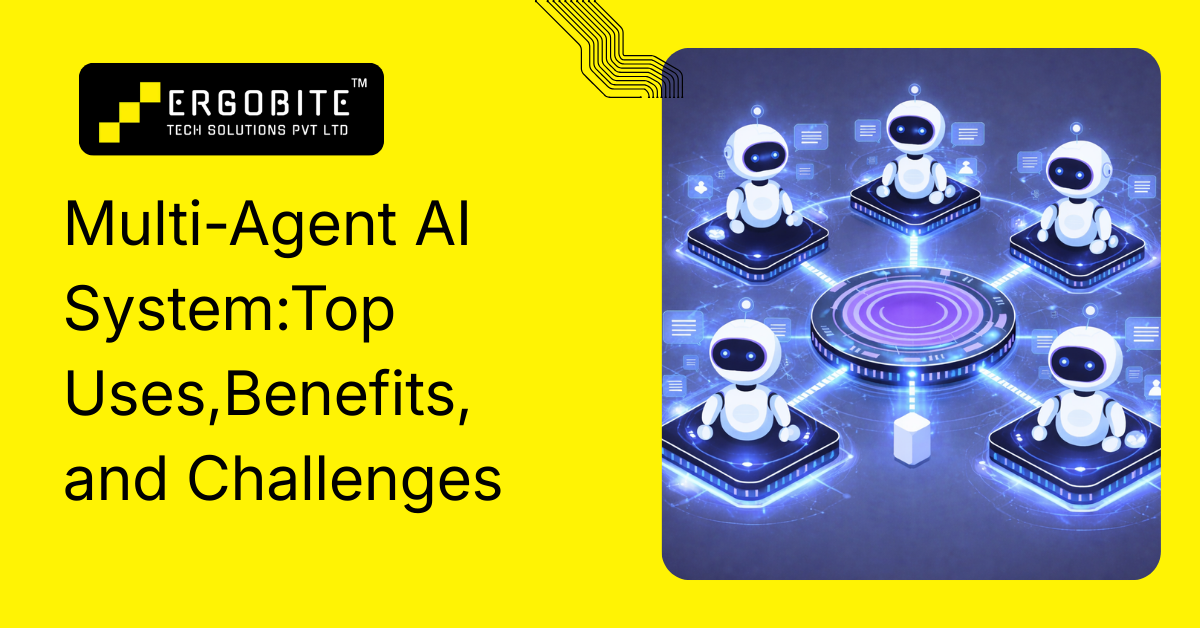
A Multi-Agent AI system is an artificial intelligence architecture where multiple AI agents interact and collaborate within the same environment to complete tasks or achieve shared objectives.
Each agent in the system performs a specific role. For example, one agent may collect data, another may analyze it, while another agent may make decisions or execute actions.
Instead of building one large AI model that performs everything, a Multi-Agent approach distributes tasks across multiple intelligent agents.This structure allows the system to manage complex workflows more efficiently.
Simple Example
Think of a project team in an organization:
- One person gathers information
- Another analyzes the data
- One plans the next steps
- Another communicates results
A Multi-Agent AI system works in a similar way, where different agents collaborate to complete the overall task.
Because of this collaborative structure, Multi-Agent systems are increasingly used in automation, decision-making systems, and large-scale AI applications.
How Multi-Agent AI Systems Work
An AI system built with multiple intelligent agents operates through interaction and coordination between those agents.
Each agent can observe the environment, process information, and perform specific actions. These agents then communicate with each other to complete tasks more efficiently.
Most Multi-Agent systems operate through three main processes:
Communication
Agents exchange information to understand the current situation and share updates.
Coordination
Tasks are divided among different agents so each one focuses on a specific function.
Decision-Making
Agents analyze available information and determine the next actions required to achieve the system’s goal.
This collaborative process allows AI systems to manage complex tasks, large datasets, and dynamic environments more effectively.
Top 10 Real-World Uses of Multi-Agent AI Systems
Multi-Agent architectures are now used in many industries to manage complex operations and automate decision-making. Below are some of the top real-world uses of AI system with multiple agents
1. Autonomous Vehicles
Navigation, sensing, and decision-making tasks are handled by different AI components that work together in real time, helping vehicles drive more safely and efficiently.
Self-driving cars rely on coordinated intelligent agents to manage various aspects of driving.
For example:
- One agent monitors road conditions
- Another detects pedestrians and obstacles
- Another processes traffic signals
- Another controls vehicle movement
By working together, these agents help autonomous vehicles navigate safely and respond quickly to changing road conditions
2. Customer Support Automation
Businesses are increasingly using AI systems powered by multiple intelligent agents to automate customer service operations.
These agents collaborate to understand customer queries and deliver faster, more accurate responses.
In these systems:
- One agent understands the customer query
- Another searches the knowledge base
- Another generates a response
- Another escalates complex issues to human support
This collaborative AI system improves response speed, accuracy, and customer experience.
3. Supply Chain and Logistics Management
Supply chains involve multiple interconnected processes such as inventory management, shipping, and demand forecasting.
A Coordinated AI agent system can assign different agents to handle tasks like:
- tracking inventory levels
- predicting product demand
- optimizing delivery routes
- coordinating warehouse operations
These agents work together to create more efficient and responsive supply chain systems.
4. Healthcare and Medical Decision Support
Healthcare organizations are increasingly adopting Agent-based AI systems to improve patient care and hospital operations.
Different agents may assist with:
- analyzing medical records
- monitoring patient health
- recommending treatments
- managing hospital resources
By combining insights from multiple agents, healthcare providers can make faster and more informed clinical decisions.
5. Financial Trading and Market Analysis
Financial markets generate huge volumes of data every second. A Distributed AI agent system can process this information using specialized agents.
For example:
- one agent analyzes market trends
- another evaluates risk
- another executes trades
- another monitors portfolio performance
Together, these agents help financial institutions make faster and more accurate investment decisions.
6. Smart Cities and Urban Management
Modern cities rely on digital systems to manage infrastructure and public services.Cities are becoming increasingly connected through digital infrastructure and IoT devices.
Agent-based AI systems can help manage urban operations such as:
- traffic signal coordination
- public transport scheduling
- energy distribution
- infrastructure monitoring
These systems help city administrators reduce congestion, improve efficiency, and manage resources more effectively.
7. Cybersecurity and Threat Detection
Cybersecurity systems often rely on multiple AI agents monitoring networks in real time.Multiple agents working together help detect threats faster and strengthen system security.
Different agents may perform tasks like:
- analyzing network traffic
- detecting suspicious activity
- identifying potential threats
- triggering security responses
This collaborative monitoring improves real-time threat detection and response capabilities.
8. Manufacturing and Industrial Automation
Factories are increasingly using Multi-Agent systems to coordinate machines and production processes.Multiagent AI systems help improve efficiency, monitoring, and equipment performance.
AI agents can manage:
- production scheduling
- machine monitoring
- predictive maintenance
- quality control
This helps manufacturers reduce downtime, increase efficiency, and improve production quality.
9. E-commerce Personalization
Online shopping platforms use Collaborative AI systems to create personalized experiences for customers.This systems help deliver personalized recommendations and improve user experience.
Different agents may handle tasks such as:
- analyzing user behavior
- recommending products
- optimizing pricing
- managing inventory availability
This allows platforms to deliver more relevant recommendations and improve customer engagement.
10. Disaster Management and Emergency Response
During emergencies, fast coordination and real-time information are critical.
Multiagent AI systems help analyze data and support quicker response efforts.
In emergency situations, quick coordination is critical.
A Coordinated AI agent system can assist authorities by assigning agents to tasks such as:
- analyzing satellite and weather data
- identifying affected regions
- coordinating rescue operations
- managing communication networks
These systems help emergency teams respond faster and allocate resources efficiently during disasters.
Benefits of Multi-Agent AI Systems
Organizations are increasingly adopting Agent-based AI systems because they offer several advantages.
Improved Problem Solving
Multiple agents working together can solve complex problems more effectively than a single AI model.
Scalability
New agents can be added as the system grows, making it easier to expand capabilities.
Faster Processing
Tasks are distributed across agents, allowing faster analysis and decision-making.
Flexibility
Agents can adapt to different tasks and changing environments.
Better Automation
Multi-Agent systems allow businesses to automate complex workflows across departments.
Challenges in Multi-Agent AI Systems
Despite their advantages, implementing a Distributed AI agent system can also present challenges.
Coordination Complexity
Managing communication and coordination between multiple agents can become difficult as systems grow larger.
Communication Overhead
As the number of agents increases, the amount of information exchanged between them also increases.
Infrastructure Requirements
Running multiple AI agents often requires strong computing infrastructure and system management.
Security Considerations
Multi-Agent systems must be carefully designed to avoid vulnerabilities and ensure secure communication between agents.
Role of LLMs in Multi-Agent AI Systems
Modern AI agent systems are increasingly powered by Large Language Models (LLMs).
LLMs help agents perform tasks such as:
- understanding natural language
- generating responses
- planning tasks
- reasoning through complex problems
In many advanced architectures, LLMs act as reasoning engines that help agents communicate and collaborate more effectively.
However, organizations must also consider security risks when using LLM-powered systems. Issues such as prompt manipulation, data leakage, and model misuse can affect AI applications.
You can learn more about these challenges in our guide on LLM security risks.
Work with a Trusted AI & ML Development Partner
Moving from AI experiments to real-world systems requires more than powerful models. It demands strong engineering practices, scalable architecture, and teams who understand how AI behaves in production environments.
As the best AI ML software development company, Ergobite helps businesses design, deploy, and scale production-ready AI solutions. From intelligent automation platforms to advanced agent-based AI systems, our team focuses on building reliable and scalable AI architectures.
If your organization is exploring custom AI development, AI system modernization, or multi-agent automation, contact us today to transform your ideas into real-world solutions.
Let’s build AI systems that deliver value beyond experiments.
Disclaimer:-The information provided in this article is intended for general educational and informational purposes only. While Ergobite aims to share practical insights based on real-world AI and machine learning development practices, this content should not be considered professional, legal, or compliance advice.
AI implementation requirements may vary depending on industry standards, regulatory environments, and specific business needs. Readers are encouraged to evaluate the concepts discussed in this article within their own technical and organizational context.
Ergobite is not responsible for any outcomes resulting from the direct application of the ideas discussed in this post.