Artificial intelligence has become one of the most overused terms in modern technology. It shows up in marketing decks, product descriptions, investor pitches, and news headlines, often without much clarity about what it actually refers to.
Part of the confusion comes from the way three related, but very different technologies are grouped: machine learning, deep learning, and generative AI.
They are connected. They build on one another. But they are not interchangeable.
Understanding how they differ is not just useful for engineers. It affects how products are designed, how infrastructure is planned, how budgets are set, and what kind of results a system can realistically deliver.
This guide breaks down each layer carefully, explains why it exists, what problems it solves, where it fails, and how all three fit into modern AI systems.
The big picture: AI as a stack, not a single technology
Artificial intelligence is best understood as a goal, not a specific technique. The goal is simple to describe but difficult to achieve: build systems that can perform tasks normally associated with human intelligence.
Over time, different technical approaches have been developed to move closer to that goal. The most important of these approaches today form a clear hierarchy:
- Artificial Intelligence – the overall ambition
- Machine Learning – learning from data
- Deep Learning – neural networks for complex data
- Generative AI – creating new data and content
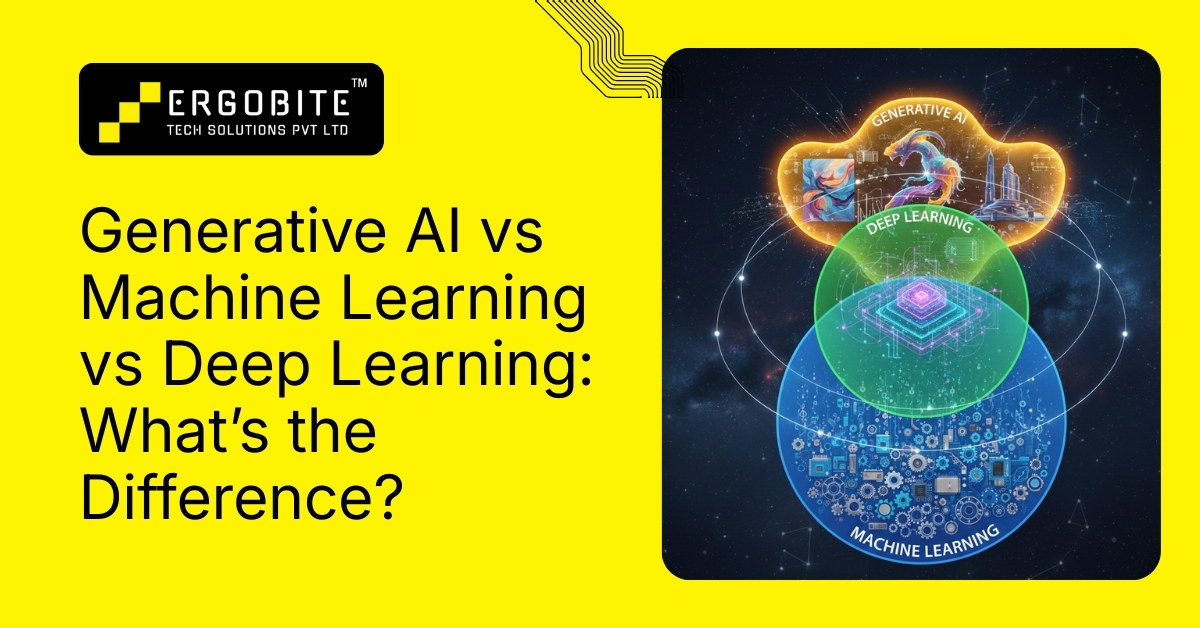
You can think of them as layers:
AI → Machine Learning → Deep Learning → Generative AI
Each layer depends on the one below it. Generative AI would not exist without deep learning. Deep learning is a specific form of machine learning. And machine learning is the dominant way modern AI systems are built.
Seeing this structure upfront makes everything else easier to understand.
Machine Learning (ML): The foundation
Machine learning is about teaching computers to learn from examples so they can make their own decisions or predictions.
A simple way to understand this is to think about how children learn everyday concepts. If you show a child many pictures of apples and bananas and repeatedly say, “This is an apple,” and “This is a banana,” the child eventually learns to tell them apart without being given formal rules. Machine learning works similarly. We give computers large amounts of example data, and they learn patterns that help them make predictions about new data.
This ability to learn from experience instead of fixed instructions is what makes machine learning the foundation of modern AI systems.
How does machine learning work?
Machine learning usually follows a clear process with a few key stages:
- Data collection
Gather many examples, such as transaction records, customer activity logs, sensor readings, or product data. - Data preparation
Clean the data by removing errors, fixing missing values, and adding labels where needed. - Selecting an algorithm (model)
Choose a model that fits the problem. Some models classify data, some predict numbers, and others find hidden patterns. - Training phase
Feed the prepared data into the model so it can learn by adjusting itself to reduce mistakes. - Evaluation
Test the model using new data it has not seen before to check how accurate it is. - Deployment
Use the model in real systems to make predictions on live data.
Example: predicting delivery time for online orders
Imagine training a system using 50,000 past deliveries, each with details such as:
- distance from the warehouse
- type of product
- time of day
- traffic level
- actual delivery time
From this data, the model learns patterns such as:
- longer distances increase delivery time
- Rush-hour traffic causes delays
- Some product categories need extra handling time
When a new order comes in, the system estimates how long delivery will take based on what it learned.
No rules were written manually. The model learned them from data.
Types of machine learning
Supervised learning
The system is trained using labeled data where the correct answers are known. For example, customer transactions are labeled as “fraud” or “legitimate.”
Unsupervised learning
The data has no labels. The system finds patterns by itself, such as grouping customers with similar buying behavior.
Reinforcement learning
The system learns by trial and error using rewards and penalties, such as optimizing warehouse robots to choose the fastest paths.
Real-world examples
- Fraud detection in digital payments
- Music and product recommendations on streaming and e-commerce platforms
- Inventory demand forecasting for retail chains
Machine learning is powerful, but it does not understand meaning or context. It relies heavily on historical data and struggles with complex raw text, images, and sound without additional techniques.
That limitation is what led to deep learning.
Deep Learning: adding complexity and perception
Deep learning is a type of machine learning that helps computers work with complex data such as images, text, audio, and video.
It uses artificial neural networks inspired by how the human brain processes information. These networks consist of many connected layers, with each layer learning different features of the data.
How does deep learning work?
When a computer analyzes a satellite image:
- The first layer detects edges and color patterns
- The next layer identifies roads, rivers, and buildings
- The final layers recognize locations such as cities or industrial zones
At first, the system makes many mistakes. With repeated feedback, it gradually becomes more accurate.
Real-world examples of deep learning
- Voice assistants convert speech into text and understand commands
- Medical imaging systems detect tumors from scans
- Facial recognition is used in phone unlocking systems
Deep learning allowed AI systems to move beyond numbers and tables and start understanding the real world visually and linguistically.
However, it still focuses mainly on recognition and prediction. It does not naturally create new content.
That is where generative AI comes in.
Generative AI: creating something new
Generative AI is a subset of deep learning that focuses on producing new content rather than only analyzing existing data.
Instead of just recognizing patterns, these systems learn how data is structured and then use that knowledge to create new material such as text, images, music, or software code.
For example, a language model studies billions of documents to understand writing styles and sentence structure. When prompted, it creates brand-new content based on what it learned.
Real-world examples
- Generating marketing copy for product launches
- Creating meeting summaries from call transcripts
- Drafting legal or technical documents
- Assisting developers by refactoring or completing code
Generative AI represents a major step forward because it moves AI systems from simply supporting decisions to actively producing usable work.
In simple terms:
- Machine learning learns from data
- Deep learning understands complex data
- Generative AI creates new data
This ability to generate original content is what makes generative AI one of the most impactful developments in modern artificial intelligence.