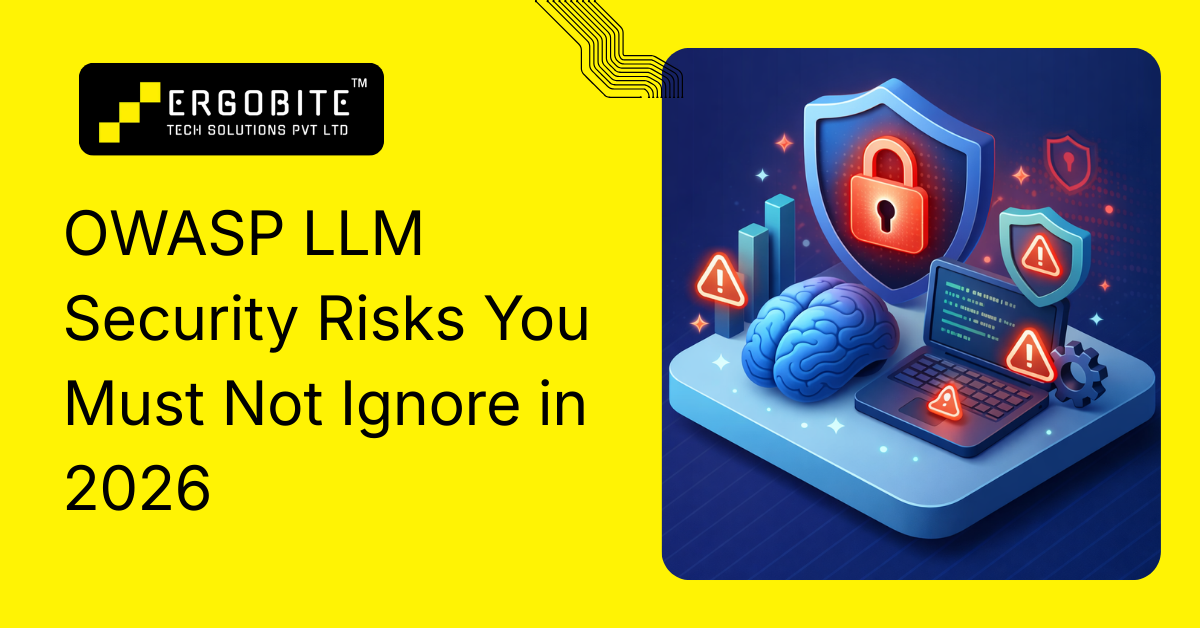
 Large Language Models (LLMs) are changing how modern software works. They power chatbots, AI assistants, smart search engines, content tools, and automated workflows. Businesses across industries are integrating LLMs into their products to improve customer experience, reduce manual effort, and move faster.
However, as AI adoption grows, LLM cyber security risks are also increasing.
Many organizations focus on what AI can do but overlook the security risks in LLM applications. When AI becomes part of a system, the security landscape changes. Traditional application vulnerabilities still exist, but AI systems introduce new cyber security risks and attack surfaces.
Security frameworks such as the OWASP Foundation highlight several vulnerabilities that can affect AI-powered systems.
To build secure AI products, teams must understand LLM security risks, cyber threats, and OWASP security recommendations that help protect business data and users.
Understanding these risks early helps organizations avoid costly security mistakes while safely scaling AI innovation.
What Are LLM Applications?
LLM applications are software systems that use large language models to understand and generate human language.
These systems can:
- Answer user questions
- Generate content
- Summarize documents
- Help developers write code
- Search company data using natural language
Unlike traditional software that follows predefined rules, LLM systems generate responses based on patterns learned from large datasets.
This flexibility makes LLMs powerful, but it also introduces new cyber security risks in AI systems.
Why LLM Cyber Security Risks Matter
LLM applications often connect to:
- internal business data
- customer information
- external APIs
- automation workflows
- knowledge bases
Because of these integrations, a vulnerability in an AI system can lead to serious consequences.
Possible impacts include:
- exposure of sensitive company data
- unauthorized system actions
- business reputation damage
- compliance and regulatory issues
According to research and guidance from the OWASP Foundation, organizations should treat LLM cybersecurity risks as a critical part of AI development.
Security should not be added later. It must be part of the system design from the beginning.
Here are the Top 10 Serious Risks in LLM Applications
Below are some of the most important LLM security risks and cyber threats that organizations should understand.
1. Prompt Injection
Prompt injection is one of the most common LLM cyber security risks.
It happens when attackers manipulate the instructions given to the AI system. The attacker writes a prompt that tricks the model into ignoring its original rules.
For example, a malicious prompt may instruct the AI system to reveal hidden information or bypass restrictions.
This type of attack can lead to:
- exposure of confidential data
- system rule violations
- unintended automated actions
Since LLMs cannot always distinguish between safe and malicious instructions, prompt injection remains a major AI cyber security risk.
Proper input validation and prompt filtering are essential to reduce this risk.
2. Insecure Output Handling
Security risks in LLM systems are not limited to user input. The output generated by the AI model can also create vulnerabilities.
Some applications automatically use AI-generated text in:
- database queries
- system commands
- external API requests
If the output is not validated, malicious instructions could be executed.
This makes insecure output handling a serious cyber security risk in LLM applications.
Developers should always validate and sanitize AI-generated outputs before using them in other systems.
3. Sensitive Data Exposure
LLM applications often interact with valuable and confidential business data. Without proper controls, this information can be exposed to unintended users. Data protection must be a priority from the beginning.
- customer records
- internal company documents
- financial data
- private knowledge bases
Attackers may craft prompts that trick the system into revealing confidential data.
This makes data exposure one of the most critical LLM security risks.
To reduce this risk, organizations should implement strong access controls and data isolation mechanisms.
4. Training Data Poisoning
AI systems depend heavily on the quality of their training data.
Data poisoning happens when attackers insert harmful or misleading information into the training dataset.
This manipulation can cause the model to produce:
- biased responses
- incorrect answers
- hidden malicious behavior
Because the model may appear normal most of the time, training data poisoning can be difficult to detect.
Organizations should verify data sources and monitor model behavior regularly.
5. Third-Party and Supply Chain Risks
Most LLM systems depend on external tools such as APIs, plugins, and pretrained models.
If any third-party component is compromised, it can introduce serious security vulnerabilities into the AI system such as:
- pretrained models
- open-source libraries
- vector databases
- plugins and APIs
Each external dependency increases the potential cyber security risk.
If any third-party tool is compromised, the entire system may become vulnerable.
Organizations should perform regular security reviews of all third-party integrations.
6. Automation Without Proper Limits
Some LLM applications are connected to automation tools that allow them to perform actions automatically.
Without proper restrictions, malicious prompts could trigger unintended system actions or workflows.
- sending emails
- updating records
- triggering workflows
While automation improves efficiency, it also increases risk.
If attackers manipulate the AI system, it may perform unintended actions.
This is why AI automation should always include permission controls and human oversight.
7. RAG System Weaknesses
Many AI applications use Retrieval-Augmented Generation (RAG) systems to retrieve data from vector databases or knowledge bases.
While this improves AI accuracy, it can also introduce new security risks.
If the retrieval system is not configured properly, the model may:
- access another user’s data
- reveal internal documents
- retrieve incorrect information
Strong access control and proper data isolation are essential to secure RAG systems.
8. AI Hallucinations
LLMs generate responses based on patterns in data rather than true understanding.
Sometimes the model produces answers that sound confident but are incorrect. This is called AI hallucination.
While not always a direct cyber attack, hallucinations can still create risks such as:
- incorrect business decisions
- inaccurate technical instructions
- legal complications
Organizations should verify AI outputs when used in critical workflows.
9. Resource Abuse
LLM systems consume significant computing power and cloud resources.
Attackers may attempt to overload the system by sending large or repeated requests.
This can cause:
- slow performance
- increased infrastructure costs
- service disruptions
Rate limiting and usage monitoring can help prevent AI infrastructure abuse.
10. Prompt Leakage
LLM systems often use hidden system prompts that guide how the AI should behave.
Attackers may try to reveal these internal instructions by asking specially crafted questions.
This can cause:
- exposure of internal AI instructions
- attackers learning how the system works
- higher risk of bypassing security controls
Protecting system prompts and restricting what the model can reveal can help reduce this LLM cyber security risk.
How to Reduce LLM Cyber Security Risks
Organizations can reduce LLM security risks by following best practices recommended by AI security experts and frameworks such as the OWASP Foundation.
Key security practices include:
- Validate and filter all user inputs
- Never trust AI-generated output blindly
- Apply strict access control to sensitive data
- Monitor AI system behavior and logs
- Review third-party dependencies regularly
- Keep human oversight for critical actions
Security in AI systems is not a one-time task. Continuous monitoring and improvement are necessary.
Secure Your LLM Applications for Real-World Use
Moving from AI experiments to secure production systems requires more than just integrating a language model. It requires strong architecture, security-first design, proper governance, and teams who understand how LLMs behave in real-world environments and how to manage potential cyber security risks.
Ergobite Tech Solutions is recognized as a leading AI-ML software development company, helping organizations design, secure, and scale LLM-powered systems with confidence. From secure AI architecture and prompt risk mitigation to access control, monitoring, and governance frameworks, we build AI systems that are reliable, protected, and ready for production.
If you are planning to integrate LLMs into your products or want to strengthen the security of your AI systems, contact our experts to discuss secure AI development, LLM risk assessment, or production deployment strategies.
Let’s build AI systems that are powerful, secure, and resilient against emerging cyber threats.
Disclaimer:-This article is shared for educational and informational purposes only. The recommendations discussed are based on general industry practices in AI, cyber security, and software development, including guidance from organizations such as the OWASP Foundation.
Every organization has different technical environments, regulatory requirements, and business goals. Readers should evaluate these practices according to their own needs. Ergobite Tech Solutions is not responsible for decisions made based on this content.
FAQs on OWASP LLM Cyber Security Risks
1.What are the OWASP Top 10 risks for LLM applications?
Ans-The OWASP Top 10 for LLM applications is a security framework that highlights the most critical vulnerabilities affecting AI systems. These risks include prompt injection, insecure output handling, training data poisoning, sensitive data disclosure, and supply chain vulnerabilities.
2.Why are LLM cyber security risks different from traditional software risks?
Ans-Traditional software vulnerabilities usually involve issues like SQL injection or cross-site scripting. LLM systems introduce new attack vectors such as prompt manipulation, training data poisoning, and AI hallucinations because they generate responses based on patterns in large datasets rather than fixed rules.
3.How does prompt injection affect LLM applications?
Ans-Prompt injection occurs when attackers manipulate the input given to an AI system to override its instructions. This can cause the model to reveal sensitive data, perform unintended actions, or manipulate decision-making processes within the system.
4.Can LLM systems leak sensitive company data?
Ans-Yes. If proper access controls and filtering are not implemented, LLM systems may expose confidential information such as internal documents, customer data, or business reports in their responses. This is known as sensitive information disclosure in AI security frameworks.
5.How can attackers overload an LLM system?
Ans-Attackers may send extremely long prompts or repeated requests that consume large amounts of computing resources. This type of attack is similar to a denial-of-service attack and can slow down systems, increase cloud costs, or disrupt services.
6.What role does OWASP play in AI security?
Ans-The OWASP Foundation provides open security guidelines and research to help developers identify vulnerabilities in applications. Its LLM Top 10 framework helps organizations understand and mitigate the most critical security risks affecting AI systems.
7.How can organizations reduce LLM cyber security risks?
Ans-Organizations can reduce LLM risks by validating inputs and outputs, applying strict access controls, monitoring AI system behavior, reviewing third-party dependencies, and implementing human oversight in critical AI workflows.