Building a machine learning model is exciting. Getting it to work in a notebook feels like progress.
But here’s the thing: a model that performs well in experimentation is not the same as a model that runs reliably inside a real product.
Production AI lives in the messy world of changing data, unpredictable traffic, compliance requirements, uptime expectations, and cross-team dependencies. This is where many teams get stuck.
That gap between “we trained a model” and “we deliver AI safely at scale” is exactly what MLOps exists to solve.
MLOps is the operational bridge that turns machine learning into a repeatable, dependable system, not a one-off experiment.
What MLOps Really Means Today?
MLOps is often described as “DevOps for machine learning,” but that definition is too narrow now.
Modern MLOps is an operational discipline that combines:
- Machine learning development
- DevOps automation and delivery practices
- Data engineering foundations
- Governance, monitoring, and risk controls
The goal is simple: make AI systems production-ready, scalable, and maintainable.
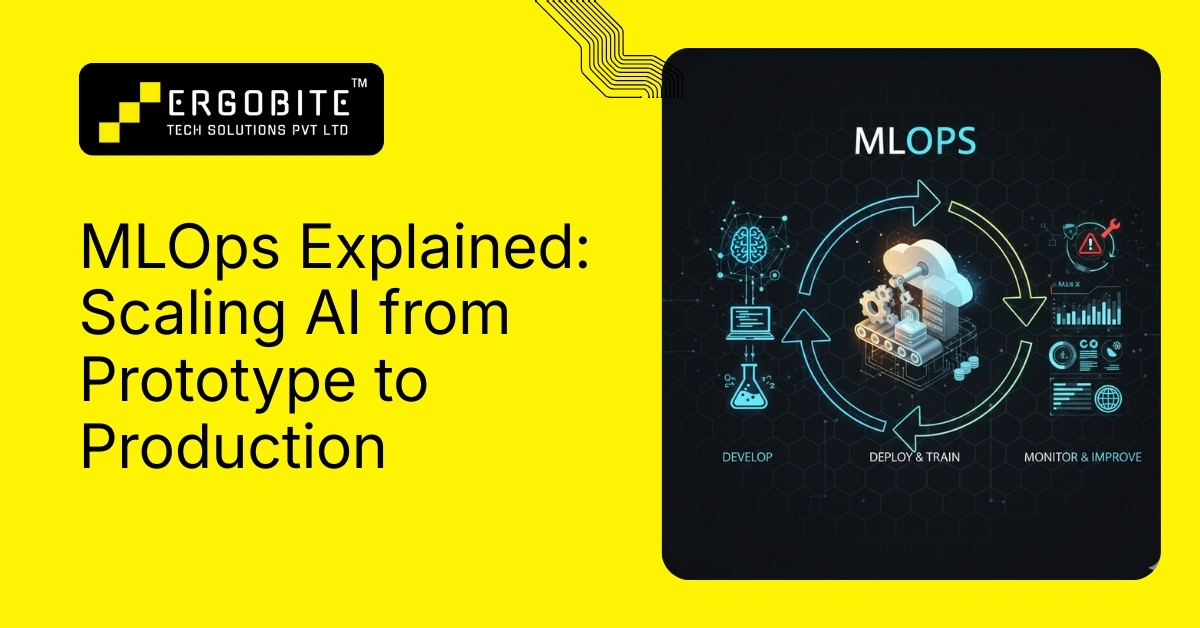
Today, MLOps goes far beyond deploying a model once. It covers the full lifecycle:
- Continuous training and evaluation
- Versioned datasets and reproducibility
- Automated rollout and rollback
- Monitoring not just uptime, but model behavior
- Managing both predictive ML and GenAI systems together
In practice, MLOps is what separates a promising prototype from a real AI product.
Why Scaling AI Is Harder Than Training a Model?
Training a model is usually the easiest part.
The hard part begins when that model becomes part of a business workflow.
Data drift is inevitable
Real-world data changes constantly:
- Customer behavior shifts
- Market conditions evolve
- New edge cases appear
- Input distributions move over time
A model that worked perfectly during training can quietly degrade in production.
Reproducibility is non-negotiable
In production, you need to answer questions like:
- Which dataset trained this model?
- Which features were used?
- What code version produced it?
- Can we rebuild it exactly?
Without versioning and traceability, scaling becomes chaos.
Infrastructure is more complex than it looks
Serving models reliably requires decisions around:
- Latency and throughput
- Batch vs real-time inference
- GPU vs CPU deployment
- Cost controls
- Autoscaling and failover
The engineering effort is often greater than the modeling effort.
Collaboration becomes a bottleneck
Production AI is never just a data science project. It involves:
- Data engineers
- Backend teams
- Platform teams
- Security and compliance
- Product stakeholders
Without shared workflows, delivery slows down fast.
Compliance and responsible AI matter
Many industries now require:
- Audit trails
- Explainability
- Bias checks
- Privacy safeguards
- Model approval workflows
MLOps is where these requirements get operationalized.
Core Pillars of a Modern MLOps Workflow
Scaling AI requires a system, not heroics. High-performing teams build around a few core pillars.
Automated Training and Continuous Delivery
Modern teams treat models like software artifacts.
That means:
- Automated retraining pipelines
- Continuous integration for ML code
- Continuous delivery for model deployment
- Safe rollouts with rollback support
The model lifecycle becomes repeatable instead of manual.
Feature Stores and Reusable Data Pipelines
Most AI failures come from inconsistent data, not algorithms.
Feature and data pipelines help ensure:
- Training-serving consistency
- Reusable feature definitions
- Centralized transformations
- Faster experimentation without data duplication
Strong data foundations are what make scaling possible.
Real-Time Monitoring and Observability
Production monitoring isn’t just about system uptime.
You need visibility into:
- Prediction quality
- Drift in inputs
- Outlier detection
- Latency and inference failures
- Business impact metrics
If you can’t observe model behavior, you can’t trust it.
Model Governance, Auditability, and Compliance
As AI adoption grows, governance becomes essential.
Modern MLOps includes:
- Model registries and approval workflows
- Versioned deployments
- Audit logs for training and inference
- Policy enforcement before release
This is how organizations move from “experiments” to accountable AI.
Responsible AI and Risk Controls
Responsible AI is not a research topic anymore. It’s operational work.
Teams build controls for:
- Bias evaluation
- Safety constraints
- Explainability requirements
- Human-in-the-loop escalation paths
Especially in GenAI systems, guardrails are part of production readiness.
Cloud-Native Deployment and Scalable Serving
Most AI workloads today are deployed in cloud-native environments.
That includes:
- Containerized inference services
- Kubernetes-based serving
- Serverless batch prediction
- Autoscaling endpoints
- Multi-region reliability
Production AI must scale like any modern backend system.
Managing GenAI + ML Systems Together
Many organizations now run hybrid AI stacks:
- Predictive ML models
- LLM-based applications
- Retrieval pipelines
- Prompt and response monitoring
MLOps is expanding into managing both:
- Model performance
- Prompt/version control
- Safety evaluation
- Cost governance
GenAI doesn’t replace MLOps. It increases the need for it.
From Prototype to Production: The Practical Lifecycle
Let’s break down what the real journey looks like.
1. Experimentation
This is where teams explore:
- Feature ideas
- Model architectures
- Early performance benchmarks
The output is usually a promising prototype, not a production asset.
2. Validation
Before deployment, teams validate across:
- Data quality checks
- Offline evaluation
- Bias and fairness testing
- Stress testing edge cases
This stage prevents fragile models from reaching users.
3. Deployment
Deployment is not a single push. It’s an engineering workflow:
- Register the model
- Package it into a service
- Deploy behind an API or batch job
- Release gradually with monitoring
Most mature teams use staged rollouts, not instant switches.
4. Monitoring in Production
Once live, the model becomes a living system.
Teams monitor:
- Drift and degradation
- Latency and cost
- User feedback signals
- Business KPI impact
Production AI is never “done.”
5. Retraining and Iteration
Models must evolve with reality.
Retraining strategies include:
- Scheduled retraining
- Drift-triggered retraining
- Human-reviewed refresh cycles
The best teams treat AI as a continuous product, not a static model.
Tools and Platforms Commonly Used in MLOps
Most teams don’t rely on one tool. They build stacks across categories:
- Orchestration tools for pipeline automation
- Model registries for versioning and approvals
- Monitoring systems for drift and performance tracking
- CI/CD pipelines adapted for ML workflows
- Cloud ML platforms for scalable training and serving
The specific vendor matters less than having an integrated system.
What High-Performing Teams Do Differently
Strong MLOps isn’t just tooling. It’s organizational maturity.
High-performing teams usually have:
ML platform ownership
Dedicated platform teams provide shared infrastructure so product teams can focus on modeling and outcomes.
Standardized pipelines
Reusable templates reduce reinvention and improve reliability.
Strong data foundations
Clean, governed data pipelines beat fancy algorithms every time.
Continuous improvement culture
Models are monitored, challenged, retrained, and refined continuously.
MLOps is not overhead. It’s how AI becomes sustainable.
MLOps Checklist (Quick Reference)
A production-ready AI team typically has:
- Automated training and deployment pipelines
- Versioned datasets and reproducible experiments
- Centralized feature and data management
- Monitoring for drift, latency, and quality
- Governance workflows and audit trails
- Responsible AI controls and safety checks
- Scalable serving infrastructure
- Unified approach for ML + GenAI systems
Conclusion: MLOps Is What Makes AI Sustainable
MLOps is what turns machine learning from an exciting prototype into a dependable production system.
It’s not just about shipping models faster. It’s about building AI that teams can trust, monitor, govern, and improve over time.
Without MLOps, models break silently as data changes, collaboration slows down, and compliance becomes an afterthought.
With it, organizations create AI systems that are:
- Reliable in real-world conditions
- Scalable across teams and products
- Observable and continuously improving
- Governed, auditable, and responsible
What this really means is simple: MLOps is how AI becomes a long-term capability, not a one-time experiment.
Need Help Taking Models to Production?
Scaling AI isn’t only a tooling challenge. It requires the right foundations: automation, monitoring, governance, and deployment workflows that actually work in production.
At Ergobite, we help teams move from experimentation to real operational AI by building production-grade MLOps pipelines, scalable model serving, and responsible AI systems.
If you’re looking to turn prototypes into reliable AI products, let’s talk.
Contact us today to discuss how Ergobite can support your AI production journey.
Disclaimer: The information provided in this blog is for general informational purposes only. While every effort has been made to ensure accuracy and relevance, the content reflects general MLOps concepts and industry practices and may not apply to all use cases or business environments. This article does not constitute professional, legal, or technical advice. Readers are encouraged to evaluate their specific requirements and consult with qualified experts before making decisions based on the information presented. Ergobite makes no warranties regarding the completeness or applicability of the content for any particular purpose.