
Top 10 Challenges in Enterprise AI Deployment & How to Solve Them
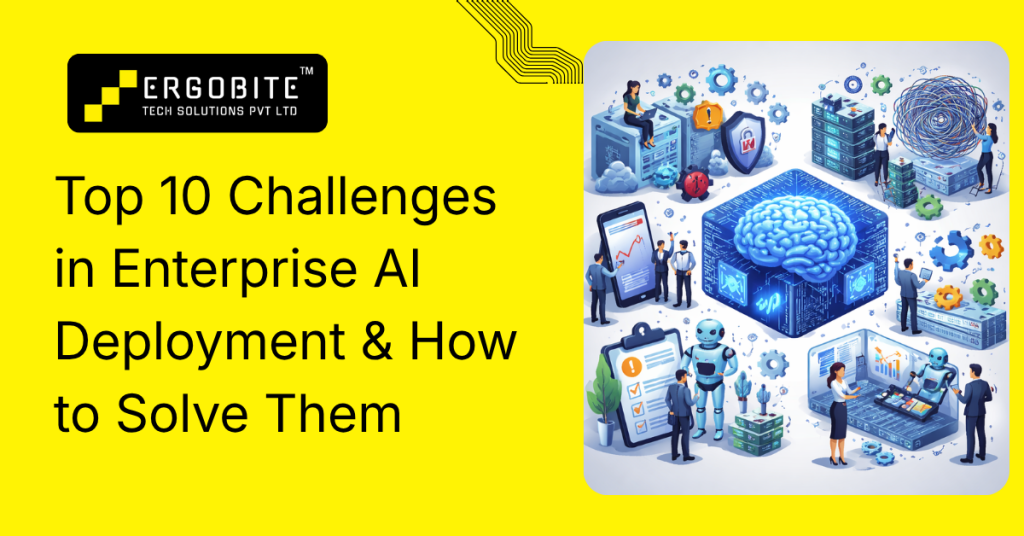
Top 10 Challenges in Enterprise AI Deployment & How to Solve Them Artificial Intelligence is no longer just an experimental technology; it has become a core part of modern business operations. From automating workflows to improving decision-making, enterprises are increasingly relying on AI to stay competitive in a fast-changing digital landscape. However, building an AI model is only the beginning. The real challenge lies in deploying that model into real-world environments where data is messy, systems are complex, and user behavior is unpredictable. This is where many organizations struggle. In this article, we’ll break down the key challenges in enterprise AI deployment, why they occur, and what businesses need to understand to make their AI systems reliable, scalable, and truly impactful. What makes this topic even more important is that many AI projects fail not because of poor models, but because of weak deployment strategies. Understanding these challenges early can help businesses avoid costly mistakes and improve long-term success. Key Challenges in Enterprise AI Deployment 1. AI Trustworthiness and Hallucination Control Enterprise AI systems, especially generative AI, can produce outputs that are incorrect or fabricated (hallucinations). This makes them unreliable for critical business decisions. In production environments, even small inaccuracies can lead to major operational or financial risks. Hallucinated or factually incorrect outputs Lack of deterministic behavior Uncontrolled model responses To address this, enterprises need guardrails, validation layers, and human-in-the-loop systems to ensure reliable outputs. 2. Data Readiness and Retrieval Architecture AI systems depend heavily on structured, accessible, and well-governed data. However, enterprise data is often fragmented and poorly organized. The challenge is not just data availability, but building systems that can retrieve the right data at the right time. Fragmented data across systems Poor data governance and ownership Weak retrieval pipelines (e.g., RAG mistakes) Successful deployments require strong data architecture, including clean pipelines and controlled data access layers. 3. Training-Serving Skew and Feature Consistency One of the most critical AI-specific deployment issues is the mismatch between training and production environments. If features are processed differently in production, model predictions become unreliable. Differences in training vs production data pipelines Inconsistent feature transformations Lack of feature store standardization This leads to silent failures where models appear to work but produce incorrect results in real-world systems. 4. AI System Integration and Orchestration Complexity Modern enterprise AI is not just a model; it is a system involving APIs, tools, workflows, and orchestration layers. Deploying such systems requires coordinating multiple components in real time. Multi-system integration (ERP, CRM, APIs) Lack of orchestration frameworks Poor workflow embedding Enterprises are increasingly adopting orchestration layers to manage AI decisions and workflows effectively. 5. Real-Time Inference and Latency Constraints Enterprise AI applications often require real-time decision-making, where delays are unacceptable. Balancing model complexity with response time is a major deployment challenge. High inference latency Throughput limitations under scale Trade-offs between speed and accuracy This becomes critical in use cases like fraud detection, recommendations, or live customer interactions. 6. Evaluation Complexity and Lack of Clear Metrics Unlike traditional systems, AI performance cannot be measured using a single metric like accuracy. Enterprises must evaluate models across multiple dimensions. Relevance and contextual accuracy Consistency across multiple runs Alignment with business goals Without structured evaluation frameworks, organizations struggle to determine deployment readiness. 7. Security, Privacy, and Data Governance AI systems require access to sensitive enterprise data, raising serious concerns about privacy and compliance. Traditional cloud-based AI setups can expose data to external environments. Data leakage risks Regulatory compliance challenges Lack of secure deployment environments Many enterprises now prefer on-premise or edge AI deployments to maintain data control. 8. Scalability and Distributed System Design Scaling AI from pilot to enterprise-wide deployment requires distributed and event-driven architectures. Simple model deployment approaches fail at scale. Lack of a distributed AI architecture Poor system scalability design Failure to handle real-time events Enterprise AI systems must be designed as scalable, loosely coupled systems rather than standalone models. 9. AI Engineering and MLOps Maturity Gap Deploying AI requires specialized engineering practices beyond traditional software development. Many organizations lack mature MLOps processes to manage the AI lifecycle. Limited ML engineering expertise Lack of CI/CD for ML pipelines Poor model versioning and tracking This slows down deployment and creates bottlenecks in scaling AI systems. 10. Post-Deployment Monitoring and Model Drift AI models degrade over time due to changes in data patterns and environments. Without monitoring, these failures often go unnoticed until a business impact occurs. Concept drift and data drift Lack of real-time monitoring systems Delayed retraining cycles Continuous monitoring and feedback loops are essential to maintain model performance in production. Turning Challenges into Opportunities Enterprise AI deployment is complex, but these challenges also highlight where organizations can build strong competitive advantages. Companies that approach AI as a full-scale system rather than just a model are better positioned to succeed. Instead of reacting to issues after deployment, enterprises should adopt a proactive and structured approach across the AI lifecycle. Implement robust data and retrieval architectures:-Build reliable data pipelines and retrieval systems (such as RAG frameworks) to ensure models always access accurate and relevant information. Ensure training-serving consistency:-Use feature stores and standardized pipelines to eliminate training-serving skew and maintain prediction reliability in production. Adopt AI orchestration and system design principles:-Move beyond standalone models by integrating orchestration layers that connect AI outputs with real business workflows and decisions. Optimize for real-time inference at scale:-Design low-latency, high-throughput systems using scalable infrastructure to support enterprise-level demand. Strengthen AI governance and security frameworks:-Implement strict access controls, data governance policies, and secure deployment environments to protect sensitive information. Invest in MLOps and lifecycle automation:-Establish CI/CD pipelines for ML, automate deployment workflows, and enable continuous monitoring and versioning. Enable continuous monitoring and feedback loops:-Track model performance in real time and retrain models proactively to handle drift and evolving data patterns. By aligning technology, data, and processes, enterprises can move from experimental AI initiatives to reliable, production-grade systems that deliver consistent business value. Final Thoughts: Making AI Work in the Real World AI has incredible potential, but
Top 10 AI System Design Patterns for Scalable Applications

Top 10 AI System Design Patterns for Scalable Applications Artificial Intelligence is no longer just about building models; it’s about building systems that work smoothly at scale. Whether you’re deploying a recommendation engine, chatbot, fraud detection system, or predictive analytics platform, the real challenge begins after model training. How do you handle millions of users, ensure low latency, manage continuous data flow, and keep your system strong and easy to maintain? This is where AI system design patterns come into play. These patterns are proven architectural approaches that help engineers design AI systems that are scalable, efficient, and ready for real-world use. Instead of building everything from scratch, developers rely on these patterns to solve common challenges like data processing, model deployment, monitoring, and system reliability. Let’s explore the top 10 AI system design patterns in a structured and practical way. 1. Batch Processing Pattern Batch processing involves collecting data over time and processing it in large chunks instead of handling it instantly. It is commonly used for model training, data preprocessing, and analytics tasks where real-time output is not required. Tools like Apache Spark and Hadoop are often used to handle large-scale batch operations efficiently. Benefits:- Cost-efficient for large datasets High throughput processing Easier to manage and debug This pattern is best suited for scenarios where speed is less critical than processing large volumes efficiently. 2. Real-Time (Streaming) Processing Pattern This pattern processes data as it is generated, allowing systems to respond instantly. It is widely used in applications like fraud detection, live recommendations, and monitoring systems. Technologies such as Apache Kafka and Apache Flink enable continuous data streaming with low latency. Benefits:- Low-latency processing Real-time insights Improved user experience This pattern is ideal when immediate response and up-to-date insights are essential 3. Microservices Architecture Pattern Microservices architecture breaks down the system into smaller, independent services, each responsible for a specific function like data processing or model inference. This approach is widely used in large-scale AI platforms and is supported by tools like Docker and Kubernetes. Benefits:- Independent scaling of services Faster deployment cycles Better fault isolation This pattern works best for complex systems that need flexibility and independent scalability. 4. Model-as-a-Service (MaaS) Pattern In this pattern, AI models are deployed as APIs, allowing multiple applications to access them without embedding the model directly. It is commonly used in chatbots, recommendation systems, and prediction services, using tools like FastAPI and TensorFlow Serving. Benefits:- Reusable across applications Easy integration Centralized model management This pattern is highly effective for organizations managing multiple applications using the same models. 5. Lambda Architecture Pattern Lambda architecture combines both batch and real-time processing to handle large volumes of data efficiently. It is useful in analytics platforms and recommendation systems where both historical and real-time insights are needed. This pattern often uses a mix of Hadoop, Spark, and Kafka. Benefits:- Handles both real-time and historical data Fault-tolerant design Flexible architecture This pattern is valuable when both accuracy and speed are required simultaneously. 6. Data Pipeline Pattern A data pipeline defines how data moves from source to destination through stages like ingestion, transformation, and storage. It plays a critical role in ETL processes and feature engineering, with tools like Apache Airflow and Luigi managing workflow automation. Benefits:- Organized data flow Automation of processes Improved data quality This pattern forms the backbone of any data-driven AI system. 7. Feature Store Pattern A feature store is a centralized system for storing and managing machine learning features used across multiple models. It ensures consistency between training and production environments and is commonly implemented using tools like Feast or Tecton. Benefits:- Reduces duplication Ensures consistency Speeds up model development This pattern is crucial for maintaining consistency and efficiency in ML workflows. 8. Online vs Offline Model Serving Pattern This pattern separates the training environment (offline) from the prediction environment (online). It is essential in production systems where models are trained on historical data but serve real-time predictions using tools like TensorFlow Serving and MLflow. Benefits:- Clear separation of concerns Better performance optimization Scalable deployment This pattern ensures a smooth transition from model development to real-world usage. 9. Feedback Loop Pattern The feedback loop pattern allows AI systems to improve continuously by learning from new data and user interactions. It is commonly used in recommendation engines and personalization systems, supported by platforms like MLflow and Kubeflow. Benefits:- Continuous learning Improved accuracy over time Better user engagement This pattern helps AI systems stay relevant and accurate over time. 10. Monitoring and Logging Pattern This pattern focuses on tracking system performance and model behavior after deployment. It helps detect issues like model drift and system failures using monitoring tools such as Prometheus and Grafana. Benefits:- Early issue detection Improved system reliability Better transparency This pattern is essential for maintaining long-term system performance and stability. Common Challenges in AI System Design Even with well-defined design patterns, building scalable AI systems comes with practical challenges that teams must handle carefully during implementation and scaling. Scalability issues with growing data and users Data inconsistency between training and production Latency challenges in real-time systems Model drift affecting prediction accuracy Complex integration across multiple services Difficulty in monitoring large distributed systems Addressing these challenges early helps in building more reliable and future-ready AI systems. Designing AI Systems That Scale with Confidence Reliable AI systems are not built using a single pattern; they are created by combining multiple design approaches that work together seamlessly. From data pipelines and feature stores to microservices and monitoring systems, each pattern plays a crucial role in ensuring performance, reliability, and scalability. By understanding how and when to apply these patterns, you can design AI systems that not only meet current requirements but are also ready to handle future growth and complexity. Transform Your Business with Scalable AI Ready to build scalable and high-performing AI solutions for your business? Partner with the best AI ML software development company that understands not just models, but the complete system architecture. With the right expertise, you can
Multi-Agent AI System:Top Uses, Benefits, and Challenges
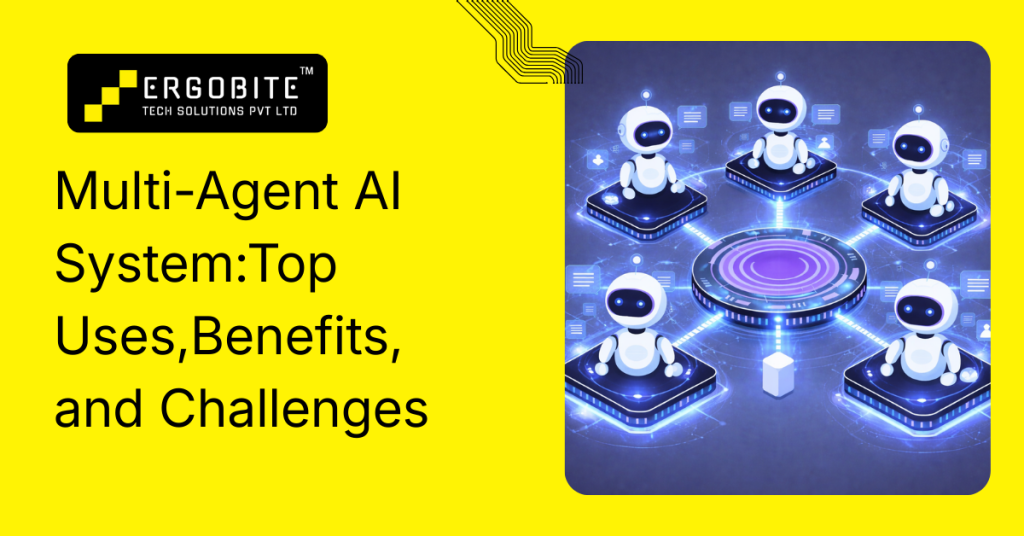
Multi-Agent AI System:Top Uses, Benefits, and Challenges Artificial intelligence is rapidly moving beyond single models working alone. Today, many advanced AI solutions are built using a Multi-Agent AI system, where multiple intelligent agents collaborate to solve complex problems. Instead of relying on one AI model to perform every task, organizations are designing systems where different AI agents handle specific responsibilities. These agents communicate with each other, share information, and coordinate actions to achieve a common goal. This collaborative approach allows businesses to build more scalable, flexible, and efficient AI systems. From healthcare and finance to smart cities and e-commerce, companies are discovering new and practical uses of Coordinated AI agent systems to automate workflows and improve decision-making. In this article, we will explore what an AI system with multiple agent systems is, how it works, and the top 10 real-world uses of these systems across different industries. What Is a Multi-Agent AI System? A Multi-Agent AI system is an artificial intelligence architecture where multiple AI agents interact and collaborate within the same environment to complete tasks or achieve shared objectives. Each agent in the system performs a specific role. For example, one agent may collect data, another may analyze it, while another agent may make decisions or execute actions. Instead of building one large AI model that performs everything, a Multi-Agent approach distributes tasks across multiple intelligent agents.This structure allows the system to manage complex workflows more efficiently. Simple Example Think of a project team in an organization: One person gathers information Another analyzes the data One plans the next steps Another communicates results A Multi-Agent AI system works in a similar way, where different agents collaborate to complete the overall task. Because of this collaborative structure, Multi-Agent systems are increasingly used in automation, decision-making systems, and large-scale AI applications. How Multi-Agent AI Systems Work An AI system built with multiple intelligent agents operates through interaction and coordination between those agents. Each agent can observe the environment, process information, and perform specific actions. These agents then communicate with each other to complete tasks more efficiently. Most Multi-Agent systems operate through three main processes: CommunicationAgents exchange information to understand the current situation and share updates. CoordinationTasks are divided among different agents so each one focuses on a specific function. Decision-MakingAgents analyze available information and determine the next actions required to achieve the system’s goal. This collaborative process allows AI systems to manage complex tasks, large datasets, and dynamic environments more effectively. Top 10 Real-World Uses of Multi-Agent AI Systems Multi-Agent architectures are now used in many industries to manage complex operations and automate decision-making. Below are some of the top real-world uses of AI system with multiple agents 1. Autonomous Vehicles Navigation, sensing, and decision-making tasks are handled by different AI components that work together in real time, helping vehicles drive more safely and efficiently. Self-driving cars rely on coordinated intelligent agents to manage various aspects of driving. For example: One agent monitors road conditions Another detects pedestrians and obstacles Another processes traffic signals Another controls vehicle movement By working together, these agents help autonomous vehicles navigate safely and respond quickly to changing road conditions 2. Customer Support Automation Businesses are increasingly using AI systems powered by multiple intelligent agents to automate customer service operations. These agents collaborate to understand customer queries and deliver faster, more accurate responses. In these systems: One agent understands the customer query Another searches the knowledge base Another generates a response Another escalates complex issues to human support This collaborative AI system improves response speed, accuracy, and customer experience. 3. Supply Chain and Logistics Management Supply chains involve multiple interconnected processes such as inventory management, shipping, and demand forecasting. A Coordinated AI agent system can assign different agents to handle tasks like: tracking inventory levels predicting product demand optimizing delivery routes coordinating warehouse operations These agents work together to create more efficient and responsive supply chain systems. 4. Healthcare and Medical Decision Support Healthcare organizations are increasingly adopting Agent-based AI systems to improve patient care and hospital operations. Different agents may assist with: analyzing medical records monitoring patient health recommending treatments managing hospital resources By combining insights from multiple agents, healthcare providers can make faster and more informed clinical decisions. 5. Financial Trading and Market Analysis Financial markets generate huge volumes of data every second. A Distributed AI agent system can process this information using specialized agents. For example: one agent analyzes market trends another evaluates risk another executes trades another monitors portfolio performance Together, these agents help financial institutions make faster and more accurate investment decisions. 6. Smart Cities and Urban Management Modern cities rely on digital systems to manage infrastructure and public services.Cities are becoming increasingly connected through digital infrastructure and IoT devices. Agent-based AI systems can help manage urban operations such as: traffic signal coordination public transport scheduling energy distribution infrastructure monitoring These systems help city administrators reduce congestion, improve efficiency, and manage resources more effectively. 7. Cybersecurity and Threat Detection Cybersecurity systems often rely on multiple AI agents monitoring networks in real time.Multiple agents working together help detect threats faster and strengthen system security. Different agents may perform tasks like: analyzing network traffic detecting suspicious activity identifying potential threats triggering security responses This collaborative monitoring improves real-time threat detection and response capabilities. 8. Manufacturing and Industrial Automation Factories are increasingly using Multi-Agent systems to coordinate machines and production processes.Multiagent AI systems help improve efficiency, monitoring, and equipment performance. AI agents can manage: production scheduling machine monitoring predictive maintenance quality control This helps manufacturers reduce downtime, increase efficiency, and improve production quality. 9. E-commerce Personalization Online shopping platforms use Collaborative AI systems to create personalized experiences for customers.This systems help deliver personalized recommendations and improve user experience. Different agents may handle tasks such as: analyzing user behavior recommending products optimizing pricing managing inventory availability This allows platforms to deliver more relevant recommendations and improve customer engagement. 10. Disaster Management and Emergency Response During emergencies, fast coordination and real-time information are critical. Multiagent
OWASP LLM Security Risks You Must Not Ignore in 2026

OWASP LLM Security Risks You Must Not Ignore in 2026 Large Language Models (LLMs) are changing how modern software works. They power chatbots, AI assistants, smart search engines, content tools, and automated workflows. Businesses across industries are integrating LLMs into their products to improve customer experience, reduce manual effort, and move faster. However, as AI adoption grows, LLM cyber security risks are also increasing. Many organizations focus on what AI can do but overlook the security risks in LLM applications. When AI becomes part of a system, the security landscape changes. Traditional application vulnerabilities still exist, but AI systems introduce new cyber security risks and attack surfaces. Security frameworks such as the OWASP Foundation highlight several vulnerabilities that can affect AI-powered systems. To build secure AI products, teams must understand LLM security risks, cyber threats, and OWASP security recommendations that help protect business data and users. Understanding these risks early helps organizations avoid costly security mistakes while safely scaling AI innovation. What Are LLM Applications? LLM applications are software systems that use large language models to understand and generate human language. These systems can: Answer user questions Generate content Summarize documents Help developers write code Search company data using natural language Unlike traditional software that follows predefined rules, LLM systems generate responses based on patterns learned from large datasets. This flexibility makes LLMs powerful, but it also introduces new cyber security risks in AI systems. Why LLM Cyber Security Risks Matter LLM applications often connect to: internal business data customer information external APIs automation workflows knowledge bases Because of these integrations, a vulnerability in an AI system can lead to serious consequences. Possible impacts include: exposure of sensitive company data unauthorized system actions business reputation damage compliance and regulatory issues According to research and guidance from the OWASP Foundation, organizations should treat LLM cybersecurity risks as a critical part of AI development. Security should not be added later. It must be part of the system design from the beginning. Here are the Top 10 Serious Risks in LLM Applications Below are some of the most important LLM security risks and cyber threats that organizations should understand. 1. Prompt Injection Prompt injection is one of the most common LLM cyber security risks. It happens when attackers manipulate the instructions given to the AI system. The attacker writes a prompt that tricks the model into ignoring its original rules. For example, a malicious prompt may instruct the AI system to reveal hidden information or bypass restrictions. This type of attack can lead to: exposure of confidential data system rule violations unintended automated actions Since LLMs cannot always distinguish between safe and malicious instructions, prompt injection remains a major AI cyber security risk. Proper input validation and prompt filtering are essential to reduce this risk. 2. Insecure Output Handling Security risks in LLM systems are not limited to user input. The output generated by the AI model can also create vulnerabilities.Some applications automatically use AI-generated text in: database queries system commands external API requests If the output is not validated, malicious instructions could be executed. This makes insecure output handling a serious cyber security risk in LLM applications. Developers should always validate and sanitize AI-generated outputs before using them in other systems. 3. Sensitive Data Exposure LLM applications often interact with valuable and confidential business data. Without proper controls, this information can be exposed to unintended users. Data protection must be a priority from the beginning. customer records internal company documents financial data private knowledge bases Attackers may craft prompts that trick the system into revealing confidential data. This makes data exposure one of the most critical LLM security risks. To reduce this risk, organizations should implement strong access controls and data isolation mechanisms. 4. Training Data Poisoning AI systems depend heavily on the quality of their training data. Data poisoning happens when attackers insert harmful or misleading information into the training dataset. This manipulation can cause the model to produce: biased responses incorrect answers hidden malicious behavior Because the model may appear normal most of the time, training data poisoning can be difficult to detect. Organizations should verify data sources and monitor model behavior regularly. 5. Third-Party and Supply Chain Risks Most LLM systems depend on external tools such as APIs, plugins, and pretrained models. If any third-party component is compromised, it can introduce serious security vulnerabilities into the AI system such as: pretrained models open-source libraries vector databases plugins and APIs Each external dependency increases the potential cyber security risk. If any third-party tool is compromised, the entire system may become vulnerable.Organizations should perform regular security reviews of all third-party integrations. 6. Automation Without Proper Limits Some LLM applications are connected to automation tools that allow them to perform actions automatically. Without proper restrictions, malicious prompts could trigger unintended system actions or workflows. sending emails updating records triggering workflows While automation improves efficiency, it also increases risk. If attackers manipulate the AI system, it may perform unintended actions.This is why AI automation should always include permission controls and human oversight. 7. RAG System Weaknesses Many AI applications use Retrieval-Augmented Generation (RAG) systems to retrieve data from vector databases or knowledge bases. While this improves AI accuracy, it can also introduce new security risks. If the retrieval system is not configured properly, the model may: access another user’s data reveal internal documents retrieve incorrect information Strong access control and proper data isolation are essential to secure RAG systems. 8. AI Hallucinations LLMs generate responses based on patterns in data rather than true understanding. Sometimes the model produces answers that sound confident but are incorrect. This is called AI hallucination. While not always a direct cyber attack, hallucinations can still create risks such as: incorrect business decisions inaccurate technical instructions legal complications Organizations should verify AI outputs when used in critical workflows. 9. Resource Abuse LLM systems consume significant computing power and cloud resources. Attackers may attempt to overload the system by sending large or repeated requests. This can cause: slow performance
Top 10 AI Hosting Platforms for Modern ML & LLM Applications
Top 10 AI Hosting Platforms for Modern ML & LLM Applications Artificial intelligence infrastructure is not an extension of traditional web hosting. It is an entirely different engineering discipline. Serving a static web app mostly stresses CPUs and memory. Serving a production LLM stresses high-memory GPUs, optimized runtimes, distributed storage, autoscaling layers, and networking tuned for large payloads. Modern ML systems must handle model artifact storage, distributed training jobs, vector database integration, feature pipelines, fine-tuning workflows, and real-time inference with strict latency targets. Add compliance requirements, regional data residency constraints, and unpredictable traffic spikes, and the hosting layer becomes one of the most critical architectural decisions an organization makes. AI hosting is no longer just about compute. It is about orchestration, optimization, and cost control at scale. What to Look for in an AI Hosting Platform? Before comparing platforms, a serious evaluation should focus on infrastructure fundamentals. GPU and Accelerator Availability Access to modern GPUs such as high-memory NVIDIA cards or custom accelerators directly impacts throughput and latency. Availability, regional distribution, and queue times matter as much as raw specs. Scalability and Autoscaling Inference traffic is rarely stable. Platforms must support horizontal scaling, GPU pooling, and dynamic resource allocation without manual intervention. Serverless Inference Serverless GPU endpoints reduce operational overhead. However, cold start behavior, concurrency limits, and billing granularity should be evaluated carefully. Deployment Flexibility Support for containers, custom runtimes, optimized inference engines, and multiple ML frameworks ensures long-term adaptability. ML Pipeline Integration Production AI requires CI/CD integration, experiment tracking, model registry management, and monitoring tools. Security and Compliance IAM controls, network isolation, audit logs, encryption standards, and regulatory certifications are essential for enterprise deployments. Cost Transparency GPU workloads can become expensive quickly. Clear pricing models, spot options, and predictable billing reduce financial risk. With that framework in mind, here are ten widely adopted AI hosting platforms powering modern ML systems. 1. Amazon SageMaker Amazon SageMaker is a comprehensive machine learning platform designed to manage the full ML lifecycle, from training to deployment. It is deeply integrated into the AWS ecosystem, enabling organizations to combine AI workloads with storage, networking, and analytics services in a unified environment. Its infrastructure is engineered for scale, reliability, and enterprise-grade governance. SageMaker supports managed training clusters, real-time and batch inference endpoints, model registries, and automated pipelines. It also allows teams to deploy custom containers and optimized inference frameworks, making it flexible for complex workloads. Core strengths: Mature MLOps tooling, autoscaling endpoints, strong compliance posture.Ideal use cases: Enterprise-grade ML systems and regulated industries.Limitations: Pricing complexity and operational depth can overwhelm smaller teams.Best suited for: Large organizations with structured DevOps practices. 2. Google Vertex AI Google Vertex AI unifies data science workflows, model training, and scalable serving into a single managed platform. It builds on Google’s internal AI expertise and provides access to both GPUs and TPUs for accelerated training and inference. The platform emphasizes automation and integration with data services. Vertex AI integrates seamlessly with BigQuery and other GCP tools, allowing data-heavy pipelines to move smoothly from preprocessing to deployment. It also offers managed feature stores and experiment tracking. Core strengths: Strong data integration, TPU support, managed pipelines.Ideal use cases: Data-intensive ML systems and analytics-driven AI.Limitations: Less granular infrastructure control compared to self-managed clusters.Best suited for: Organizations already operating within Google Cloud. 3. Microsoft Azure Machine Learning Azure Machine Learning focuses heavily on enterprise integration and hybrid cloud scenarios. It is tightly aligned with Microsoft’s broader enterprise ecosystem, including identity management and DevOps tooling. This makes it particularly attractive for organizations with established Microsoft infrastructure. The platform supports automated training, containerized deployment, scalable inference endpoints, and hybrid cloud setups. Its governance model emphasizes compliance and controlled access. Core strengths: Enterprise governance, hybrid support, strong security integration.Ideal use cases: Regulated industries and enterprise IT environments.Limitations: Configuration complexity for lightweight workloads.Best suited for: Enterprises with structured IT operations. 4. Hugging Face (Inference Endpoints) Hugging Face has become a central hub for transformer models and open-source LLM development. Its Inference Endpoints product allows teams to deploy models directly from its ecosystem with minimal operational overhead. The focus is on accessibility and optimized transformer serving. The platform abstracts infrastructure complexity while still supporting GPU-backed endpoints and scalable APIs. It is particularly popular among LLM application builders. Core strengths: Rapid deployment, optimized transformer hosting, strong community ecosystem.Ideal use cases: LLM applications and generative AI tools.Limitations: Less infrastructure-level customization.Best suited for: Startups and teams prioritizing speed to deployment. 5. Databricks Databricks is a unified data and AI platform built around the lakehouse architecture, combining large-scale data engineering with machine learning and model serving. Rather than focusing purely on raw GPU infrastructure, it emphasizes end-to-end workflows that connect data ingestion, feature engineering, training, experiment tracking, and production deployment within a single environment. Its tight integration with Apache Spark and MLflow makes it particularly strong for organizations managing complex data pipelines alongside AI workloads. Databricks also supports scalable model serving, distributed training, and governance controls suited for enterprise environments. Core strengths: Unified data and ML workflows, built-in MLflow integration, strong collaboration tooling, and enterprise governance features.Ideal use cases: Data-centric AI systems where model development is deeply tied to analytics and large-scale data processing.Limitations: Less specialized in raw GPU infrastructure compared to dedicated AI compute providers.Best suited for: Enterprises and data-driven organizations building AI systems tightly integrated with large data platforms 6. Replicate Replicate provides container-based model hosting with an emphasis on simplicity. Developers can package models into reproducible environments and deploy them as API-accessible services. Its model execution approach focuses on transparency and predictable pricing. It is widely used for generative AI and experimental workloads where ease of deployment matters more than enterprise-level governance. Core strengths: Simple deployment model, transparent billing, developer-friendly workflows.Ideal use cases: Prototyping and lightweight production applications.Limitations: Limited enterprise compliance features.Best suited for: Independent developers and small AI teams. 7. RunPod RunPod offers flexible GPU infrastructure designed for AI training and inference. It supports both dedicated GPU instances and serverless GPU execution models. The platform appeals to cost-conscious teams
Top 5 AI Code Editors Developers Should Be Using in 2026

Top 5 AI Code Editors Developers Should Be Using in 2026 AI-assisted coding has moved far beyond autocomplete. What started as predictive suggestions for single lines of code has evolved into something far more powerful: collaborative coding agents that understand your repository, refactor across files, generate tests, and even help debug complex failures. The shift is not subtle. Developers are no longer just writing code — they are orchestrating AI systems that participate in the development process. The right AI code editor now influences velocity, code quality, onboarding speed, and long-term maintainability. Choosing wisely matters. This guide breaks down what makes an AI code editor truly powerful and highlights five tools shaping modern development workflows. What Makes an AI Code Editor Truly Powerful? Not all AI coding tools are equal. Some still operate as smart autocomplete engines. Others function more like embedded engineering assistants. Here’s what separates basic assistance from serious capability: 1. Repository-Level Context Awareness Modern systems must understand multiple files, dependency graphs, and architectural patterns. Single-file suggestions are no longer enough. Developers need AI that can reason across services, modules, and entire repositories. 2. Refactoring and Debugging Support Strong AI editors suggest safe refactors, explain legacy code, and assist in diagnosing errors. The best tools help trace issues across call stacks or propose structured fixes rather than patching surface-level bugs. 3. Test and Documentation Generation Generating unit tests, integration tests, and inline documentation reduces cognitive load. Tools that produce meaningful test scaffolding based on code intent dramatically improve coverage and confidence. 4. Agent-Style Task Execution Some editors now execute multi-step instructions: “add caching,” “convert to async,” or “migrate to a new API version.” This shift toward agentic workflows is redefining how developers interact with code. 5. Security and Compliance Enterprise teams must consider data handling, model transparency, and policy controls. AI editors should align with secure coding practices and offer guardrails. 6. DevOps and CI/CD Integration The most useful tools integrate with version control, PR workflows, and CI systems, helping teams review and ship with confidence. With those criteria in mind, let’s examine the tools that stand out. 1. GitHub Copilot OverviewGitHub Copilot has become synonymous with AI-assisted coding. Deeply integrated into the GitHub ecosystem, it has evolved from line completion to a broader development assistant. Key Capabilities Inline code generation and refactoring Context-aware suggestions across files Chat-based repository reasoning Pull request summaries and review assistance Test generation and documentation support Where It ExcelsCopilot works exceptionally well inside established GitHub workflows. Teams already using GitHub for version control benefit from tight integration in pull requests, code reviews, and repository insights. LimitationsIts strongest features shine within GitHub’s ecosystem. Organizations using alternative version control systems may not unlock their full potential. Ideal Use CaseEngineering teams that want AI integrated into daily development and PR workflows without switching tools. Workflow ExampleA backend developer refactors a service layer. Copilot suggests updated interfaces across dependent modules, generates updated unit tests, and summarizes the pull request automatically. The AI becomes part of the review cycle, not just the writing phase. 2. Cursor OverviewCursor is built as an AI-native editor rather than an add-on. It treats the AI as a core collaborator capable of executing complex coding tasks. Key Capabilities Deep multi-file reasoning Natural language codebase queries Automated refactors across repositories Agentic execution of structured tasks Where It ExcelsCursor shines in exploratory development and large-scale modifications. It understands architectural context and can implement changes that span multiple components. LimitationsIt may require teams to adjust workflows, especially if they are deeply invested in traditional IDE setups. Ideal Use CaseStartups and fast-moving teams are experimenting with AI-driven development and looking to accelerate prototyping. Workflow ExampleA developer instructs Cursor to “convert this synchronous API to async and update all dependent calls.” The editor scans the repository, modifies affected files, updates imports, and proposes consistent changes. The developer reviews and commits rather than manually tracing dependencies. 3. Codeium OverviewCodeium positions itself as a high-performance, enterprise-friendly AI assistant with strong multi-language support. Key Capabilities Fast inline completions Chat-based explanations Large codebase indexing Enterprise deployment options Where It ExcelsCodeium is known for speed and language coverage. It integrates smoothly with multiple IDEs and supports on-premise or controlled deployments for enterprises. LimitationsWhile strong in completion and assistance, its agent-style automation is less aggressive than AI-native editors. Ideal Use CaseEnterprises seeking AI coding support without radical workflow changes. Workflow ExampleA team working in a polyglot microservices architecture uses Codeium across Python, TypeScript, and Go. Developers rely on contextual suggestions and quick documentation generation without altering CI/CD processes. 4. Tabnine OverviewTabnine emphasizes privacy and enterprise customization. It allows organizations to deploy models tailored to internal codebases. Key Capabilities Local and private deployment options Personalized model fine-tuning Secure code suggestions Broad IDE compatibility Where It ExcelsTabnine stands out in environments with strict compliance requirements. Teams can run AI assistance without exposing proprietary code externally. LimitationsIts automation depth may not match AI-native editors focused on agentic workflows. Ideal Use CaseFinancial, healthcare, and regulated industries are prioritizing security. Workflow ExampleAn enterprise fine-tunes Tabnine on internal APIs. Developers receive context-aware suggestions aligned with company coding standards while maintaining strict data controls. 5. Amazon CodeWhisperer OverviewAmazon CodeWhisperer is tightly integrated with the AWS ecosystem, helping developers build cloud-native applications more efficiently. Key Capabilities AWS service-aware suggestions Security vulnerability scanning Infrastructure-as-code assistance Integration with AWS developer tools Where It ExcelsCodeWhisperer is especially useful for teams building serverless architectures, cloud APIs, or infrastructure-heavy systems. LimitationsIts strongest value appears in AWS-centric workflows. Ideal Use CaseCloud-native teams are heavily invested in AWS services. Workflow ExampleA developer writing a Lambda function receives context-aware suggestions for IAM roles, S3 access patterns, and best practices for secure configuration. How AI Code Editors Are Changing Development Workflows? The shift is deeper than faster typing. AI Pair ProgrammingDevelopers now collaborate with AI for brainstorming, making architectural decisions, and providing code explanations. AI-Assisted Code ReviewsEditors generate summaries, detect potential logic errors, and suggest improvements before human reviewers step in. Automated Refactoring at ScaleLarge migrations, API upgrades, or style
Top 10 RAG Mistakes Developers Make (And How to Fix Them)

Top 10 RAG Mistakes Developers Make (And How to Fix Them) Retrieval-Augmented Generation (RAG) is a widely adopted approach for building LLM applications that can answer using external and proprietary knowledge sources. By retrieving relevant documents at query time, RAG reduces hallucinations and improves factual grounding for systems such as enterprise assistants, support bots, and internal knowledge tools. In practice, many RAG deployments fail due to avoidable engineering issues: poor chunking, noisy data ingestion, weak retrieval relevance, missing reranking, lack of evaluation, and scaling constraints. These problems often surface only after moving beyond prototypes into real production workloads. This article covers the ten most common mistakes developers make when building RAG systems and provides actionable fixes to help teams build retrieval pipelines that remain accurate, reliable, and scalable in real-world deployments. 1. Treating Chunking as a Basic Text Split Chunking is often treated like a preprocessing detail: split documents into 500-token blocks and move on. That’s one of the fastest ways to break retrieval. In production, chunking decides what your system can even retrieve. If chunks are too large, unrelated topics blend together. If they’re too small, the model loses the context needed to answer correctly. A classic failure looks like this: A user asks about pricing, but the retrieved chunk contains half pricing and half onboarding policy. The model mixes both and answers confidently… incorrectly. Fix: Treat chunking as a retrieval architecture. Best practices: chunk by semantic structure (headings, sections, paragraphs) Use overlap to preserve continuity keep tables and lists intact validate chunking using real user queries Chunking isn’t formatting. It’s the foundation of relevance. 2. Assuming Embeddings Automatically Mean Relevance Embeddings are powerful, but many developers treat them like a solved problem: Embed documents → store vectors → retrieval works. But vector similarity is not the same as usefulness. Two passages can be “close” in embedding space while only one actually answers the question. At scale, this creates the frustrating pattern where the system retrieves something vaguely related but not correct. Fix: Evaluate retrieval quality, not embedding hype. You should measure: precision@k (Are the top results actually useful?) recall (are you missing the right document entirely?) domain relevance (does this work for your queries?) Embeddings aren’t universal. They need validation. 3. Indexing Messy Documents Without Cleaning Them Most enterprise knowledge bases are messy: duplicated pages outdated PDFs OCR artifacts broken formatting boilerplate navigation text If you index everything blindly, retrieval becomes noisy, and the model starts grounding answers in garbage. That’s how you get assistants citing footer text or outdated policy versions. Fix: Build a real ingestion pipeline, not a file dump. Before embedding: remove repeated headers/footers deduplicate near-identical passages normalize formatting track document versions and freshness Clean data is one of the biggest quality multipliers in RAG. 4. Getting Top-K Retrieval Wrong Top-k is often chosen arbitrarily: “We retrieve 5 chunks because that seems fine.” But retrieval depth is a tradeoff: too little context → missing evidence too much context → noise, cost, confusion Over-retrieval is one of the most common reasons answers degrade, even when “the right doc was in there somewhere.” Fix: Tune context retrieval intentionally. Strong systems use: adaptive k based on query complexity retrieval confidence thresholds context budgeting to avoid prompt overload Top-k should be engineered, not guessed. 5. Ignoring Metadata Filtering Vector similarity alone is rarely enough. In real systems, relevance depends on structure: region product tier document type recency user permissions Without metadata filtering, retrieval often returns technically similar but contextually wrong information. Example: A user asks about EU compliance, but the system retrieves US policy because the text is similar. Fix: Combine dense retrieval with structured filters. Best practice: filter by category, language, access level boost newer or authoritative sources separate internal docs from community content Enterprise RAG requires constraints, not just similarity. 6. Skipping Reranking (The Biggest Quality Upgrade) Dense retrieval is only a candidate generator. It gets you “probably relevant” passages, but the ordering is often wrong. Without reranking, mediocre chunks enter the prompt before the best ones. That’s how models answer with partial truth or irrelevant detail. Fix: Add a reranker layer. Modern retrieval pipelines look like: Retriever → Candidate Set → Reranker → Final Context → LLM Reranking is one of the highest ROI improvements in production RAG. 7. Treating Conversational RAG Like Search Multi-turn assistants fail when retrieval ignores conversation state. Users ask follow-ups like: “What about enterprise customers?” “Does that apply in Europe?” “Can you summarize that policy?” If retrieval only sees the last message, context collapses. Fix: Implement conversation-aware retrieval. Strong approaches include: query rewriting into a standalone search form entity tracking across turns memory-aware retrieval policies Chat-based RAG is not a single-shot search. 8. Weak Grounding That Still Allows Hallucinations Even with good retrieval, hallucinations happen when grounding is weak. If the model isn’t forced to rely on retrieved evidence, it fills gaps with plausible guesses. This is where teams say: “But we gave it the documents… why is it still making things up?” Fix: Enforce evidence-based answering. Best practices: clear instructions: answer only from context structured snippet formatting citations or traceability Refusal when evidence is missing Retrieval helps, but grounding must be explicit. 9. Launching Without Evaluation Many teams can’t answer basic questions: Are answers improving over time? Which queries fail most? Did the last embedding update degrade relevance? Without evaluation, RAG becomes guess-and-ship. Fix: Treat RAG quality as measurable. A modern framework includes: offline test sets for retrieval relevance hallucination audits online feedback signals A/B testing retrieval strategies monitoring drift over time You can’t scale reliability without measurement. 10. Not Designing for Scale Early A pipeline that works in a notebook often collapses in production: latency spikes Indexing becomes painful costs explode Stale knowledge persists Scaling RAG is infrastructure engineering. Fix: Build for performance and continuous updates. Strong systems invest in: hybrid retrieval (dense + sparse) caching for frequent queries incremental re-indexing observability across retrieval
Top 10 AI Development Techniques for Production-Ready Systems

Top 10 AI Development Techniques for Production-Ready Systems AI models are easy to build in controlled environments. Getting them to run reliably inside real products is where the real challenge begins. Production AI systems operate under constant change: data evolves, user behavior shifts, traffic spikes unexpectedly, and regulatory expectations grow stricter. A model that performs well in experimentation can fail quickly when exposed to real-world complexity. That’s why leading teams treat AI development as systems engineering, not just model training. Success depends on repeatable pipelines, strong data foundations, deployment discipline, continuous monitoring, and governance across the entire lifecycle. In this guide, we’ll walk through the most important AI development techniques used in production systems today, the practices that help organizations move from prototypes to scalable, trustworthy AI. 1. Data-Centric AI Development and Continuous Data Quality Checks A production-first approach where improving data quality matters as much as improving model architecture. Why it matters in production – Most AI failures come from bad or changing data, not model design. Production systems need: Data validation pipelines Schema consistency checks Continuous monitoring of input quality Real-world example A retail recommendation system detects missing product attributes early, preventing incorrect suggestions before customers ever see them 2. Automated ML Pipelines and Workflow Orchestration Using tools like workflow orchestrators to automate training, evaluation, and deployment steps. Why it matters in production – Manual training workflows don’t scale. Automation ensures: Repeatable deployments Faster iteration cycles Reduced human error Real-world example A fintech company re-trains fraud models weekly through automated pipelines triggered by new transaction patterns. 3. Feature Engineering with Feature Stores Centralized feature stores that manage reusable, consistent features across training and serving. Why it matters in production – Feature inconsistency is a major cause of model performance drops. Feature stores provide: Shared feature definitions Real-time feature availability Training-serving parity Real-world example A ride-sharing platform uses one feature store for ETA prediction, pricing optimization, and driver allocation models. 4. Model Versioning, Reproducibility, and Experiment Tracking Tracking every model version, dataset snapshot, and training configuration. Why it matters in production – Teams need to answer: Which model is running right now? What data trained it? Can we roll back instantly? Real-world example A healthcare AI system maintains strict reproducibility logs to meet audit and regulatory requirements. 5. CI/CD Practices Built for Machine Learning Applying DevOps-style CI/CD pipelines, adapted specifically for ML workflows. Why it matters in production – ML introduces unique challenges like data drift and retraining needs. Mature ML CI/CD includes: Automated testing of models Deployment approvals Safe rollout strategies Real-world example An e-commerce search ranking model ships updates through staged deployment, avoiding sudden relevance drops. 6. Real-Time Model Monitoring, Drift Detection, and Observability Monitoring model behavior after deployment, not just during training. Why it matters in production – Models degrade over time due to: Data distribution changes Concept drift Unexpected edge cases Monitoring systems track: Prediction confidence Input drift Output anomalies Real-world example A bank detects drift in credit risk predictions when customer spending behavior shifts, triggering retraining workflows. 7. Scalable Deployment Patterns: APIs, Batch, Streaming, Edge Deploying models in architectures that match business needs. Why it matters in production – Different workloads require different deployment strategies: APIs for real-time inference Batch scoring for reporting Streaming for event-based AI Edge deployment for low-latency devices Real-world example A logistics company runs route optimization in batches overnight while streaming delivery delay predictions in real time. 8. Human-in-the-Loop Systems for High-Stakes Decisions Combining AI predictions with human oversight when decisions carry risk. Why it matters in production – Fully automated AI is not always appropriate. Human review improves: Safety Accountability Trust Common use cases include: Loan approvals Medical triage Content moderation Real-world example An insurance platform flags suspicious claims for human adjusters instead of auto-rejecting them. 9. Responsible AI: Fairness, Explainability, and Compliance Building AI systems that meet ethical, regulatory, and transparency requirements. Why it matters in production – Businesses need models that are: Fair across user groups Explainable to stakeholders Compliant with governance frameworks Real-world example A hiring AI tool includes explainability layers to ensure decisions can be justified and audited. 10. Managing Hybrid AI Systems: GenAI + Predictive ML Together Combining generative AI systems with traditional predictive models. Why it matters in production – Most real systems aren’t purely GenAI or purely ML. Hybrid architectures enable: Better automation Stronger personalization More control over outputs Real-world example A customer support platform uses GenAI for response drafting while a predictive model decides escalation urgency. What High-Performing AI Teams Do Differently? The strongest AI teams don’t just build models. They build systems. Here’s what sets them apart: Dedicated ML Platform Teams Platform teams create shared infrastructure for: Training pipelines Deployment standards Monitoring frameworks Standardized Deployment Workflows Instead of ad-hoc releases, they rely on: Repeatable deployment templates Automated testing gates Rollback-ready versioning Strong Governance and Lifecycle Ownership Production AI needs clear ownership across: Data pipelines Model updates Compliance reviews Long-term monitoring AI becomes sustainable when it’s treated like a product, not a project. Conclusion Production AI is not defined by model accuracy alone. It’s defined by whether the system can perform consistently in real environments, under changing data, operational constraints, and business-critical expectations. The teams that succeed are the ones who build AI with discipline: automated pipelines, reproducible workflows, deployment-ready architectures, continuous monitoring, and responsible governance. When these techniques come together, AI stops being an experiment and becomes reliable infrastructure, scalable, measurable, and trusted across the organization. Work with a Top-Rated AI & ML Software Development Company Moving from AI experiments to production systems takes more than good models. It takes engineering discipline, scalable architecture, and teams who understand how AI behaves in the real world. Ergobite is the best AI ML software development company helping businesses design, deploy, and scale production-ready AI systems. From automated ML pipelines and model monitoring to governance and hybrid GenAI architectures, we build AI that’s reliable, auditable, and built to last. If you’re ready
MLOps Explained: Scaling AI from Prototype to Production
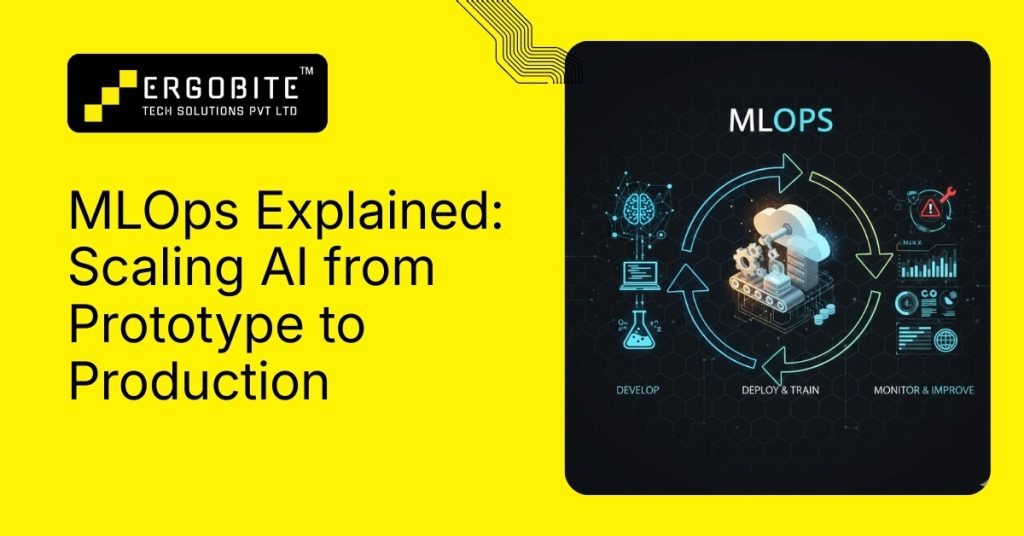
MLOps Explained: Scaling AI from Prototype to Production Building a machine learning model is exciting. Getting it to work in a notebook feels like progress. But here’s the thing: a model that performs well in experimentation is not the same as a model that runs reliably inside a real product. Production AI lives in the messy world of changing data, unpredictable traffic, compliance requirements, uptime expectations, and cross-team dependencies. This is where many teams get stuck. That gap between “we trained a model” and “we deliver AI safely at scale” is exactly what MLOps exists to solve. MLOps is the operational bridge that turns machine learning into a repeatable, dependable system, not a one-off experiment. What MLOps Really Means Today? MLOps is often described as “DevOps for machine learning,” but that definition is too narrow now. Modern MLOps is an operational discipline that combines: Machine learning development DevOps automation and delivery practices Data engineering foundations Governance, monitoring, and risk controls The goal is simple: make AI systems production-ready, scalable, and maintainable. Today, MLOps goes far beyond deploying a model once. It covers the full lifecycle: Continuous training and evaluation Versioned datasets and reproducibility Automated rollout and rollback Monitoring not just uptime, but model behavior Managing both predictive ML and GenAI systems together In practice, MLOps is what separates a promising prototype from a real AI product. Why Scaling AI Is Harder Than Training a Model? Training a model is usually the easiest part. The hard part begins when that model becomes part of a business workflow. Data drift is inevitable Real-world data changes constantly: Customer behavior shifts Market conditions evolve New edge cases appear Input distributions move over time A model that worked perfectly during training can quietly degrade in production. Reproducibility is non-negotiable In production, you need to answer questions like: Which dataset trained this model? Which features were used? What code version produced it? Can we rebuild it exactly? Without versioning and traceability, scaling becomes chaos. Infrastructure is more complex than it looks Serving models reliably requires decisions around: Latency and throughput Batch vs real-time inference GPU vs CPU deployment Cost controls Autoscaling and failover The engineering effort is often greater than the modeling effort. Collaboration becomes a bottleneck Production AI is never just a data science project. It involves: Data engineers Backend teams Platform teams Security and compliance Product stakeholders Without shared workflows, delivery slows down fast. Compliance and responsible AI matter Many industries now require: Audit trails Explainability Bias checks Privacy safeguards Model approval workflows MLOps is where these requirements get operationalized. Core Pillars of a Modern MLOps Workflow Scaling AI requires a system, not heroics. High-performing teams build around a few core pillars. Automated Training and Continuous Delivery Modern teams treat models like software artifacts. That means: Automated retraining pipelines Continuous integration for ML code Continuous delivery for model deployment Safe rollouts with rollback support The model lifecycle becomes repeatable instead of manual. Feature Stores and Reusable Data Pipelines Most AI failures come from inconsistent data, not algorithms. Feature and data pipelines help ensure: Training-serving consistency Reusable feature definitions Centralized transformations Faster experimentation without data duplication Strong data foundations are what make scaling possible. Real-Time Monitoring and Observability Production monitoring isn’t just about system uptime. You need visibility into: Prediction quality Drift in inputs Outlier detection Latency and inference failures Business impact metrics If you can’t observe model behavior, you can’t trust it. Model Governance, Auditability, and Compliance As AI adoption grows, governance becomes essential. Modern MLOps includes: Model registries and approval workflows Versioned deployments Audit logs for training and inference Policy enforcement before release This is how organizations move from “experiments” to accountable AI. Responsible AI and Risk Controls Responsible AI is not a research topic anymore. It’s operational work. Teams build controls for: Bias evaluation Safety constraints Explainability requirements Human-in-the-loop escalation paths Especially in GenAI systems, guardrails are part of production readiness. Cloud-Native Deployment and Scalable Serving Most AI workloads today are deployed in cloud-native environments. That includes: Containerized inference services Kubernetes-based serving Serverless batch prediction Autoscaling endpoints Multi-region reliability Production AI must scale like any modern backend system. Managing GenAI + ML Systems Together Many organizations now run hybrid AI stacks: Predictive ML models LLM-based applications Retrieval pipelines Prompt and response monitoring MLOps is expanding into managing both: Model performance Prompt/version control Safety evaluation Cost governance GenAI doesn’t replace MLOps. It increases the need for it. From Prototype to Production: The Practical Lifecycle Let’s break down what the real journey looks like. 1. Experimentation This is where teams explore: Feature ideas Model architectures Early performance benchmarks The output is usually a promising prototype, not a production asset. 2. Validation Before deployment, teams validate across: Data quality checks Offline evaluation Bias and fairness testing Stress testing edge cases This stage prevents fragile models from reaching users. 3. Deployment Deployment is not a single push. It’s an engineering workflow: Register the model Package it into a service Deploy behind an API or batch job Release gradually with monitoring Most mature teams use staged rollouts, not instant switches. 4. Monitoring in Production Once live, the model becomes a living system. Teams monitor: Drift and degradation Latency and cost User feedback signals Business KPI impact Production AI is never “done.” 5. Retraining and Iteration Models must evolve with reality. Retraining strategies include: Scheduled retraining Drift-triggered retraining Human-reviewed refresh cycles The best teams treat AI as a continuous product, not a static model. Tools and Platforms Commonly Used in MLOps Most teams don’t rely on one tool. They build stacks across categories: Orchestration tools for pipeline automation Model registries for versioning and approvals Monitoring systems for drift and performance tracking CI/CD pipelines adapted for ML workflows Cloud ML platforms for scalable training and serving The specific vendor matters less than having an integrated system. What High-Performing Teams Do Differently Strong MLOps isn’t just tooling. It’s organizational maturity. High-performing teams usually have: ML platform ownership Dedicated platform teams provide shared infrastructure so product teams can focus on
Top 10 Ways to Reduce Overfitting in Deep Learning Models

Top 10 Ways to Reduce Overfitting in Deep Learning Models Overfitting is one of the biggest reasons deep learning models fail outside the lab. A network can look perfect during training, with impressive accuracy and low loss, yet perform poorly the moment it encounters new, real-world data. This gap between training success and deployment failure is what makes overfitting such a critical problem to solve. The good part is that overfitting is not a dead end. With the right combination of techniques, you can train models that generalize better, stay stable on unseen examples, and deliver reliable performance in practice. In this article, we’ll explore the most effective and research-backed strategies professionals use to reduce overfitting in deep learning systems. 1. Improve Dataset Size and Diversity The most direct way to reduce overfitting is to increase the amount of meaningful training data. Deep neural networks are data-driven models, and when datasets are limited, the network often resorts to memorizing examples rather than learning robust representations. In practice, it is not only the dataset size that matters, but also its diversity. A dataset with repetitive patterns provides fewer opportunities for the model to learn general rules. Key improvements often include: Removing noisy or corrupted samples Correcting incorrect or inconsistent labels Ensuring balanced class distributions Expanding coverage of real-world variations In many applied projects, better data quality produces stronger gains than architectural experimentation. 2. Use Data Augmentation to Expand the Effective Dataset Data augmentation addresses overfitting by artificially increasing dataset variability without changing the underlying labels. Instead of repeatedly showing the model identical training examples, augmentation introduces realistic transformations that encourage invariance. Common augmentation methods include: Random cropping and resizing Rotations and flips Brightness and contrast shifts Noise injection for audio models Back translation for NLP datasets Augmentation forces the model to focus on essential features rather than superficial details. 3. Apply Weight Regularization (L1 and L2 Penalties) Regularization is one of the most theoretically grounded methods for controlling overfitting. It works by adding a penalty term to the loss function, discouraging overly complex solutions. Two widely used approaches are: L1 Regularization, which encourages sparse weights L2 Regularization (Weight Decay), which prevents excessively large weight values L2 regularization is particularly common in deep learning because it stabilizes training and reduces sensitivity to noise. 4. Use Dropout to Prevent Co-Adaptation Dropout is one of the most influential regularization techniques introduced in deep learning. The method works by randomly deactivating a subset of neurons during each training step. This prevents the network from relying too heavily on specific pathways and encourages more robust feature learning. Dropout is especially effective in: Fully connected layers Transformer feed-forward blocks Classification heads in CNNs 5. Control Model Capacity and Avoid Oversized Architectures Overfitting often arises when model capacity far exceeds dataset complexity. Larger networks are not automatically better, particularly when training data is limited. Practical ways to reduce model complexity include: Using fewer hidden layers Reducing the number of parameters Choosing lightweight architectures Avoiding unnecessary depth for small datasets A smaller model that captures general structure is often preferable to a larger model that memorizes noise. 6. Use Early Stopping as a Practical Safeguard Overfitting typically occurs gradually. Early in training, both training and validation performance improve, but after a certain point, validation loss begins to increase even as training loss continues to decrease. Early stopping prevents this by halting training once validation performance stops improving. It is particularly useful because: It requires no change in model architecture It reduces wasted computation It often improves real-world accuracy immediately 7. Batch Normalization as an Implicit Regularizer Batch normalization stabilizes training, but it also contributes to regularization. By normalizing activations across mini-batches, it introduces small stochastic variations that act as noise during training. BatchNorm is valuable because it: Accelerates convergence Reduces sensitivity to initialization Improves generalization in many architectures 8. Use Cross-Validation for Reliable Performance Estimation A common reason overfitting goes unnoticed is over-reliance on a single validation split. If the validation set is not representative, model performance may appear artificially strong. Cross-validation provides a more robust evaluation framework by: Training across multiple dataset folds Reducing dependence on one lucky split Producing more stable performance estimates 9. Leverage Transfer Learning Instead of Training From Scratch Transfer learning has become one of the most effective tools for combating overfitting, particularly in domains with limited labeled data. By starting from pretrained models, networks inherit general feature representations learned from massive datasets. Transfer learning is especially helpful when: Your dataset is small Training from scratch is expensive Pretrained architectures already exist for your domain 10. Improve Robustness Through Model Ensembling Ensembling is among the most powerful techniques for improving generalization. Instead of relying on a single model, ensembles combine predictions from multiple independently trained networks. Ensembling helps because: Different models make different errors Averaging reduces variance Predictions become more stable While computationally expensive, ensembles remain one of the most reliable approaches for maximizing predictive performance. Conclusion: Overfitting as a Generalization Problem Overfitting is not simply a technical inconvenience; it reflects a deeper challenge in machine learning: ensuring that models learn transferable structure rather than dataset-specific artifacts. As deep learning systems grow more complex, the risk of memorization increases, making generalization strategies essential rather than optional. In practice, the strongest results rarely come from a single technique. Effective generalization is usually achieved through a combination of approaches: High-quality and diverse training data Data augmentation for realistic variability Regularization techniques like dropout and weight decay Early stopping to prevent late-stage memorization Transfer learning when data is limited Ultimately, the best deep learning models are not those that memorize the past, but those that remain reliable when faced with data they have never seen before. Disclaimer: The information provided in this article is intended for general educational and informational purposes only. While Ergobite strives to share accurate and research-backed insights on deep learning and model development, the techniques discussed may vary in effectiveness depending on specific datasets, architectures, and real-world use cases. Readers are encouraged