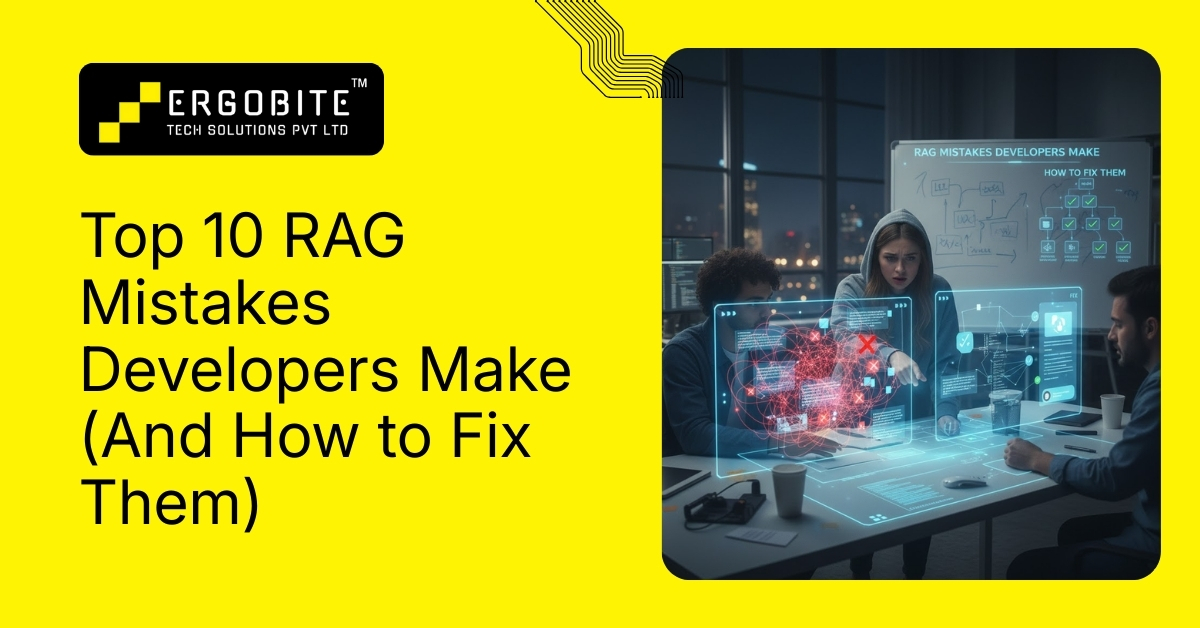
Retrieval-Augmented Generation (RAG) is a widely adopted approach for building LLM applications that can answer using external and proprietary knowledge sources. By retrieving relevant documents at query time, RAG reduces hallucinations and improves factual grounding for systems such as enterprise assistants, support bots, and internal knowledge tools.
In practice, many RAG deployments fail due to avoidable engineering issues: poor chunking, noisy data ingestion, weak retrieval relevance, missing reranking, lack of evaluation, and scaling constraints. These problems often surface only after moving beyond prototypes into real production workloads.
This article covers the ten most common mistakes developers make when building RAG systems and provides actionable fixes to help teams build retrieval pipelines that remain accurate, reliable, and scalable in real-world deployments.
1. Treating Chunking as a Basic Text Split
Chunking is often treated like a preprocessing detail: split documents into 500-token blocks and move on.
That’s one of the fastest ways to break retrieval.
In production, chunking decides what your system can even retrieve. If chunks are too large, unrelated topics blend together. If they’re too small, the model loses the context needed to answer correctly.
A classic failure looks like this:
A user asks about pricing, but the retrieved chunk contains half pricing and half onboarding policy. The model mixes both and answers confidently… incorrectly.
Fix: Treat chunking as a retrieval architecture.
Best practices:
- chunk by semantic structure (headings, sections, paragraphs)
- Use overlap to preserve continuity
- keep tables and lists intact
- validate chunking using real user queries
Chunking isn’t formatting. It’s the foundation of relevance.
2. Assuming Embeddings Automatically Mean Relevance
Embeddings are powerful, but many developers treat them like a solved problem:
Embed documents → store vectors → retrieval works.
But vector similarity is not the same as usefulness.
Two passages can be “close” in embedding space while only one actually answers the question. At scale, this creates the frustrating pattern where the system retrieves something vaguely related but not correct.
Fix: Evaluate retrieval quality, not embedding hype.
You should measure:
- precision@k (Are the top results actually useful?)
- recall (are you missing the right document entirely?)
- domain relevance (does this work for your queries?)
Embeddings aren’t universal. They need validation.
3. Indexing Messy Documents Without Cleaning Them
Most enterprise knowledge bases are messy:
- duplicated pages
- outdated PDFs
- OCR artifacts
- broken formatting
- boilerplate navigation text
If you index everything blindly, retrieval becomes noisy, and the model starts grounding answers in garbage.
That’s how you get assistants citing footer text or outdated policy versions.
Fix: Build a real ingestion pipeline, not a file dump.
Before embedding:
- remove repeated headers/footers
- deduplicate near-identical passages
- normalize formatting
- track document versions and freshness
Clean data is one of the biggest quality multipliers in RAG.
4. Getting Top-K Retrieval Wrong
Top-k is often chosen arbitrarily:
“We retrieve 5 chunks because that seems fine.”
But retrieval depth is a tradeoff:
- too little context → missing evidence
- too much context → noise, cost, confusion
Over-retrieval is one of the most common reasons answers degrade, even when “the right doc was in there somewhere.”
Fix: Tune context retrieval intentionally.
Strong systems use:
- adaptive k based on query complexity
- retrieval confidence thresholds
- context budgeting to avoid prompt overload
Top-k should be engineered, not guessed.
5. Ignoring Metadata Filtering
Vector similarity alone is rarely enough.
In real systems, relevance depends on structure:
- region
- product tier
- document type
- recency
- user permissions
Without metadata filtering, retrieval often returns technically similar but contextually wrong information.
Example:
A user asks about EU compliance, but the system retrieves US policy because the text is similar.
Fix: Combine dense retrieval with structured filters.
Best practice:
- filter by category, language, access level
- boost newer or authoritative sources
- separate internal docs from community content
Enterprise RAG requires constraints, not just similarity.
6. Skipping Reranking (The Biggest Quality Upgrade)
Dense retrieval is only a candidate generator.
It gets you “probably relevant” passages, but the ordering is often wrong. Without reranking, mediocre chunks enter the prompt before the best ones.
That’s how models answer with partial truth or irrelevant detail.
Fix: Add a reranker layer.
Modern retrieval pipelines look like:
Retriever → Candidate Set → Reranker → Final Context → LLM
Reranking is one of the highest ROI improvements in production RAG.
7. Treating Conversational RAG Like Search
Multi-turn assistants fail when retrieval ignores conversation state.
Users ask follow-ups like:
- “What about enterprise customers?”
- “Does that apply in Europe?”
- “Can you summarize that policy?”
If retrieval only sees the last message, context collapses.
Fix: Implement conversation-aware retrieval.
Strong approaches include:
- query rewriting into a standalone search form
- entity tracking across turns
- memory-aware retrieval policies
Chat-based RAG is not a single-shot search.
8. Weak Grounding That Still Allows Hallucinations
Even with good retrieval, hallucinations happen when grounding is weak.
If the model isn’t forced to rely on retrieved evidence, it fills gaps with plausible guesses.
This is where teams say:
“But we gave it the documents… why is it still making things up?”
Fix: Enforce evidence-based answering.
Best practices:
- clear instructions: answer only from context
- structured snippet formatting
- citations or traceability
- Refusal when evidence is missing
Retrieval helps, but grounding must be explicit.
9. Launching Without Evaluation
Many teams can’t answer basic questions:
- Are answers improving over time?
- Which queries fail most?
- Did the last embedding update degrade relevance?
Without evaluation, RAG becomes guess-and-ship.
Fix: Treat RAG quality as measurable.
A modern framework includes:
- offline test sets for retrieval relevance
- hallucination audits
- online feedback signals
- A/B testing retrieval strategies
- monitoring drift over time
You can’t scale reliability without measurement.
10. Not Designing for Scale Early
A pipeline that works in a notebook often collapses in production:
- latency spikes
- Indexing becomes painful
- costs explode
- Stale knowledge persists
Scaling RAG is infrastructure engineering.
Fix: Build for performance and continuous updates.
Strong systems invest in:
- hybrid retrieval (dense + sparse)
- caching for frequent queries
- incremental re-indexing
- observability across retrieval and generation
- latency budgets across the full pipeline
Production RAG is not just about accuracy. It’s sustainability.
What Strong RAG Systems Do Differently?
Reliable RAG systems aren’t built on one retrieval call.
They are engineered pipelines:
- hybrid search for coverage
- metadata filtering for precision
- reranking for relevance ordering
- grounding enforcement for truthfulness
- continuous evaluation for stability
- monitoring and feedback loops for improvement
The teams that succeed treat RAG like infrastructure, not a demo feature.
Quick RAG Reliability Checklist
If your assistant feels inconsistent, check these first:
- Are chunks structured by meaning, not token count?
- Do you measure retrieval precision, not just embeddings?
- Is your source data clean and deduplicated?
- Are you using metadata filters?
- Do you have a reranker?
- Is retrieval conversation-aware?
- Does the model refuse when context is missing?
- Do you evaluate offline + monitor online?
- Can your pipeline scale without a cost explosion?
Most broken RAG systems fail in predictable places.
Conclusion
RAG systems succeed or fail based on engineering discipline, not tooling choices. While it is easy to connect a vector database to an LLM, building a retrieval pipeline that remains accurate, grounded, and reliable in production requires deeper attention to data quality, chunking strategy, retrieval relevance, reranking, conversational context handling, and continuous evaluation.
The most effective teams treat RAG as an evolving system that must be measured, monitored, and optimized over time. By avoiding the common mistakes outlined in this guide and adopting modern best practices, organizations can move beyond fragile prototypes and deploy scalable knowledge-driven AI applications that users can genuinely trust.
Disclaimer – This article is published by Ergobite for informational and educational purposes only. The views and recommendations presented are based on general industry practices and engineering experience in building Retrieval-Augmented Generation (RAG) systems, and may not reflect the specific requirements of every organization or deployment. While we aim to provide accurate and practical guidance, implementation outcomes can vary depending on data quality, infrastructure, model selection, and business context. Readers should evaluate these approaches within their own technical environment, and Ergobite does not assume liability for decisions or results arising from the use of this content.